Of all activities in the realm of construction, nothing is as taken for granted as Earthworks. This is perhaps due to the misconception that “Soil is Soil” and that brute force alone will suffice in order to compact it. Nothing can be farther from the truth and numerous projects here and abroad have highlighted the important fact that soil can not be taken for granted as it can spell trouble in the construction site. The purpose of this paper is to focus on the special characteristics of various soils and how best to harness this knowledge for optimum construction expediency.
2. THE NATURE OF SOILS
Soil is an aggregation or assemblage of particles which are the products of weathering or decomposition or rocks. They could have been weathered in place or transported by wind or water. The manner of deposition as well as the parent material dictate how the soil behaves when subjected to loading or other environmental factors.
Soil particles are either visible to the naked eye or are submicroscopic. Being a particulate material, soil behaves differently than say a solid material. Particulate behavior can be fully understood and once this is so, the treatment of problems involving soils and soil particles becomes simpler. Soil is a structural material, but unlike other construction materials with known or predictable properties that could be specified at design stage, the engineer has to contend with what he will encounter in the field. Being a natural material, the soil will exhibit large variabilities even within the confines of a construction site. In most instances, soils must be used “as-is” and “where-is” because of its great bulk and difficulty of transporting such large volumes. Soil properties can also change with time and this must be anticipated. On the other hand, soil structure can also be altered by man in order to improve its characteristics significantly.
1) Soil Microstructure
Soil microstructure plays a very important part in the engineering behavior of soils. Soil structure can be altered or changed mechanically or chemically to produce desired characteristics for the project. Soil can either be Coarse Grained (sands and gravels) or Fine Grained (clays and silts). In addition, these soils can be adulterated say by organic materials as to effectively alter its characteristic behavior.
2) Coarse Grained Soils
Sands and gravels constitute the bulk of these soils , the individual sand grains are visible to the naked eye and are “gritty” to the trouch. Clean sands behave as particulate material. They derive their strength chiefly from contacts between the individual sand grains which results in “friction”. Although the individual grains may not be fully in contact with each other. The large concentration of stresses at the contact points produces increased resistance to sliding one past the other. Granular soil strength is essentially based on its Angle of Internal Friction “ϕ ” or its ϕ -Angle. The ϕ -Angle is not a unique value for a certain type of soil. Rather the ϕ angle is dependent on the degree of compactness of the soil and the confining pressure. The more compact and the more confined the granular soil is, the larger the ϕ -Angle. Coarse grained soils in their loose state are sensitive to vibration and are thus easily compacted by vibratory means whether very dry or in saturated state. When subjected to vibration, the loose coarse grained soils assume a denser packing and are thus compacted. A similar effect although to slightly lesser degree can be achieved by totally saturating the loose sands with water. The loose packing collapses with flooding by water and the soil assumes a denser packing.
3) Fine Grained Soils
Fine grained soils such as clays and silts are generally submicroscopic and the individual soil particles are not readily visible to the naked eye. Depending on the source or mineralogy, clays and silts may be plastic or non plastic.
Because of their very small size, the ratio of the surface area to the volume or mass is very very large and thus, surface activity due to electrochemical forces of attraction and repulsion come into play.
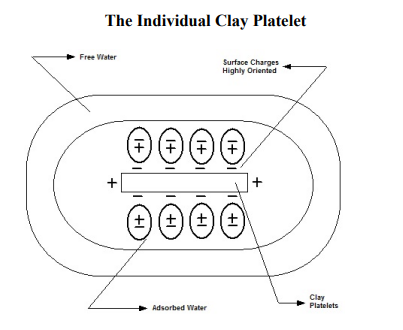
The shear strength or “cohesion” of these clays and silts are essentially derived from such forces and not through interparticle friction as one would suspect. The individual soil particles known as platelets are seldom in contact as they are surround by highly bounded adsorbed water due to electrical forces of attraction and further by absorbed water which is weakly bonded. Thus, the individual platelets slide one past the other because of these adsorb and absorbed layers of water. Compaction of this soil is dependent chiefly in expelling this absorbed water and any air with it to reduce the interparticle distance between clay platelets so that the forces of attraction is increased due to the reduction in distance. The resulting strength due to electrochemical attraction is known as “cohesion”.
4) Intermediate Soils
Intermediate soils are either predominantly granular or fine grained but have fractions of the other as to significantly alter its characteristic behavior in its unadulterated state. Data from tests made on sands used for molding indicate that its shear strength reaches a maximum and levels off with about 9 to 14% of clay depending on the clay mineral. If the clay content exceeds about 25% the strength degrades as the “Wedge Block” structure disappears and the individual sand or silt grain become separated and “floating” in a matrix of clay.2] When sufficient clay is present to form a matrix enclosing coarser grained soils (normally 25-30% clay), the structure of the clay dictates the structural behavior of the soil.
3. MOISTURE DENSITY RELATIONSHIP OF SOILS
1) Proctor Moisture Density Relationships
R.R. Proctor is generally regarded as the originator of principles dealing with a rational approach to soil compaction.3]
Proctor felt the need to have a laboratory compaction test to control field compaction operations. His first decision was the selection of a laboratory compaction energy that would simulate compaction energies imparted by construction equipment in the field.
He accomplished this by specifying a 5.5 lb hammer dropping at 12 inches height on soil samples confined in a 4″ diameter steel mold. This came to be known as “Proctor Density”.
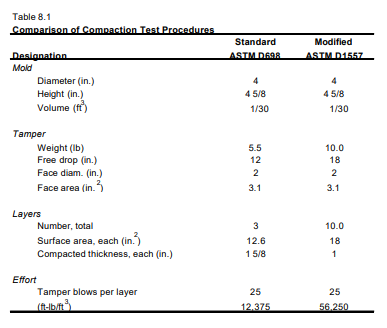
Later on, as the need for bigger airplanes and wheel loads developed during the war years, it was found that the original compaction requirements for airfields and highways would need to be increased. Thus, higher compaction requirements resulted in the use of higher hammer energies in the laboratories. This came to be known as the “Modified Proctor” and the original Proctor Density became the “Standard Proctor Density”. The table below shows the comparison between the two methods:
It can be seen from the foregoing that Modified Proctor energy is 4.51 times that of Standard Proctor Energy. The two procedures came to be standardized as:
ASTM D-698 – “Laboratory Compaction Characteristic of soil using Standard Effort (12,400 ft-lb/ft3)”
ASTM D-1557 – “Laboratory Compaction Characteristic of soil using Standard Effort (56,000 ft-lb/ft3)”
There is a large difference in the compaction energy (and effort) needed in the laboratory and in the field to move from Standard to Modified Proctor Density.
Sometimes unknowingly or through ignorance, Engineers or the owner would specify the degree of relative compaction without specifying the reference as say: “to be compacted to 95% MDD” where: “to be compacted to 95% MDD based on ASTM D-698” would have been more appropriate.
4. IS THE PROCTOR MOISTURE DENSITY RELATIONSHIP APPRO-PRIATE FOR ALL SOILS?
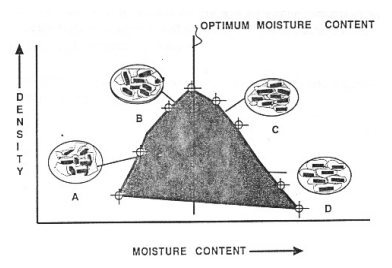
This question does not often surface because there has been an implicit acceptance of this as the reference procedure for the compaction of all soils. In point of truth, this is not so as relatively clean coarse grained soils are insensitive to moisture content except in the extreme ranges of being very dry or highly saturated. The concept of “Optimum Moisture Content” (OMC) therefore is not applicable to clean coarse grained “Free Draining” soils such as sands and gravels.
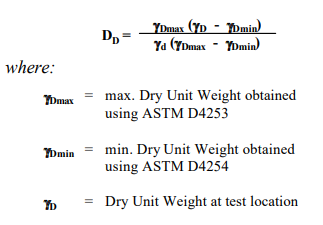
The compaction of clean coarse grained soils are not referenced against Proctor Densities (Standard or Modified) but rather on the concept of Relative Density (DR) using ASTM D4253 “maximum Index Density and Unit Weight of Soils using a Vibratory Table” and ASTM D4254 “minimum Index Density and Unit Weight of Soils and Calculation of Relative Density” and plugging the minimum and maximum values obtained therefrom to arrive at the reference relative density DD for the material.
Thus, the Relative Density of the soil as calculated is different from the Proctor Density. Why then is Proctor Density still being specified for even clean sands? We can only guess that this is because of plain ignorance or probably the lack of test equipment for this test in the country. Although, relative compaction and Proctor maximum densities can be used, one is never sure whether the maximum density has been allowed or not. In most cases this is not attained.
1] Emilio M. Morales holds a Master’s Degree in Civil Engineering from Carnegie Mellon University, PA., USA and is currently the Chairman Geotechnical Specialty Committee. Currently, He is the Technical Director of Philippine GEOANALYTICS, Inc. Soils and Materials Testing Laboratory and can be reached through e-mail: pgamain@pgatech.com.ph www.pgatech.com.ph
2] Spangler, M. “Soil Engineering”. 4th Ed. Harper & Row Publishers. NY, NY 1982.
3] Monohan, E. “Construction of and on Compacted Fills”. Wiley & Sons, Inc. NY, NY 1986.
Abstract : The phenomenon of Swelling soils in the country is now only slowly being recognized, and Oftentimes only when this has manifested itself in the form of extensive damage to the structures or pavements. Most often, this phenomenon is wrongly attributed to settlement and the remedial or response measures are directed to correct the perceived “settlement” which based on the experiences of the Authors do not solve the problem and sometimes even aggravate or accentuate the problem by causing more damage.
Swelling soils are prevalent in the country due to the widespread deposition of Volcanic ash and materials. Because most of the published literature concerning swelling soils are from US sources or from South Africa particularly where these soils occur in dry desert climates, the occurrence of swelling soils in wet tropical climates have been wrongly discounted or ignored often with disastrous results.
This paper seeks to explore and explain the phenomena causing swelling and the attendant damage based on a “local setting” in order to highlight the importance. It has been said that 80% of the solution is in the identification of the problem and this is the focus of the Paper by the authors. The remaining part of the solution, the last 20% is directed towards Avoidance, Defensive measures before construction, as well as Remediation in case the problem has already manifested itself.
1 INTRODUCTION
Potentially expansive soils find wide distribution in the Philippines. The problems are most often unrecognized until it is too late and most often expansion or heaving is misinterpreted as “settlement”. Most of the time, damage to facilities and infrastructure is significant and very costly to repair and remediate.
The key to avoidance is early detection and this can be done initially by performing very simple and inexpensive soil index tests.
2 THE FORMATION OF SWELLING SOILS
Swelling soils find wide distribution in areas of volcanic deposition or origin with tropical climate and also in arid and/or semi desert climates. In tropical volcanic settings,
alumina rich volcanic ash gets deposited in general over a wide area. Some get concentrated in depressions or low areas which are almost always inundated or saturated with water. This regular inundation tends to leach the alumina and concentrate these at the bottom 1.0 meter to 2.0 meters generally but could be deeper depending on the leaching effects.
This explains the sporadic occurrence of expansive soils as generally, the expansive soils are not deposited area wide and thus portions of the project footprint may or may not be underlain by these soils.
3 ORIGIN OF SWELLING SOILS
In tropical volcanic environments, volcanic soils rich in alumina is deposited as Aeolian deposits. These Aeolian deposits settle in the land and are thicker in depressed areas. The alumina gets leached and concentrated due to ponding and saturation in the depressed areas. This alumina is the primary source of the expansive tendency and most often are shallow in occurrence due to the limited leveling effects.
4 DAMAGE TO STRUCTURES (Ref. 2.0)
Type of damages. Damages sustained by structures include: distortion and cracking of pavements and on-grade floor slabs; cracks in grade beams, walls, and drilled shafts; jammed or misaligned doors and windows; and failure of steel or concrete plinths (or blocks) supporting grade beams. Lateral forces may lead to buckling of basement and retaining walls, particularly in overconsolidated and non- fissured soils. The magnitude of damages to structures can be extensive, impair the usefulness of the structure, and detract aesthetically from the environment. Maintenance and repair requirements can be extensive, and the expenses can grossly exceed the original cost of the foundation.
Occurrence of damages. Damages can occur within a few months following construction, may develop slowly over a period of about 5 years, or may not appear for many years until some activity occurs to disturb the soil moisture. The probability of damages increases for structures on swelling foundation soils if the climate and other field environment, effects of construction, and effects of occupancy tend to promote moisture changes in the soil.
5 MECHANISM FOR MOISTURE INGRESS AND REMOVAL
Cyclical Water Ingress and Removal causes moisture imbalance that triggers the “Shrink-Swell Cycles”.
The cyclical nature of the “shrink-swell cycle” is caused by the periodic entry and evacuation of water in the soil. If only moisture equilibrium can be maintained within the structure then the damage due to cyclic movements of water into and out of the soil can be prevented or minimized. This points to one remediation measure that could be effective in remediating existing structures that have experienced damage due to swelling and shrinking of the soils.
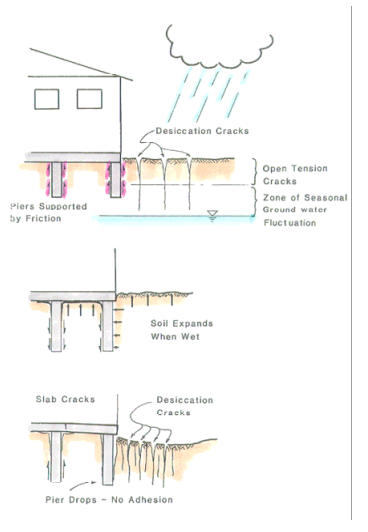
The figure above taken from Ref. 4.0 shows how water can find its way into and under a structure. In addition several other soil mechanisms and behavior tend to cause this cyclic movement of soils into and out of the structure footprint causing shrink swell cycles.
The following properties help us to understand the swell and shrink tendency of highly plastic soils:
FINE GRAINED SOILS possess characteristic Crystal Lattices that are very small and could not normally be seen even under a Microscope.
These Crystals possess electrical charges. The finer the crystals the greater is the surface area and the attractive electrical charges.
The electrical attractive forces and the high affinity for water are very great as to cause separation of the clay platelets to adsorb the water and cations.
This continued adsorption and absorption causes the swelling of the soil which could be reversible during periods of evapotraspiration and Matric suction.
This phenomenon causes the shrink swell cycle.
Salt Cations in the soil water are attracted to the surface of the Lattice crystals to balance the Charges. These salt cations such as magnesium, alumina, sodium, potassium are dissolved in the soil water and adsorbed on the clay surfaces as exchangeable cations.
The hydration of these Cations can cause the attraction and accumulation of water between the clay particles.
Other Factors that Contribute to this are:
Soil Plasticity
Dry Density – the greater the density, the greater the expansive potential.
Initial Moisture Content
Moisture variation – if the moisture is balanced and there are no variations in moisture then the cycle is interrupted.
The figure above shows how Moisture variation is caused by natural processes. In addition to this, water tend to move from hotter areas to cooler areas (such as under structures) in a process known as “Thermal Migration”. Thus over a period of time water would be slowly injected underneath structures further aided by Matric Suction.
The moisture buildup does NOT necessarily coincide with periods of high rainfall or Moisture such as during flooding. This is because the fine grained nature of the expansive soils have very low permeability and thus we would sometimes find that swelling would occur after the rainy season or in a dry spell after considerable time from the exposure to inundation or saturation.
However, continued inundation or flooding of a surrounding area could cause heaving to occur after a period of time.
6 PATTERNS OF HEAVE
There are several patterns of heaving (Ref. 2.0) due to swelling soils that could occur or affect a structure depending on the Ground water regime or water infiltration and also the timing of construction:
6.1 Doming Heave Heave can occur as an upward long term dome shaped movement that develops over many years.
6.2 Cycle Heave A cyclic contraction – expansion related to drainage and the frequency and amount of rainfall and evaporation.
6.3 Edge Heave This kind of heave may be observable soon after construction in preconstruction vegetation and lack of topographic relief. Removal of vegetation leads to an increase in soil moisture while flat topography leads to ponding.
6.4 Lateral Heave Lateral thrust of expansive soil with a horizontal force approaching the passive earth pressure can cause bulging and fracture of basement walls and retaining walls.
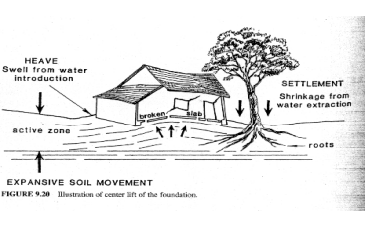
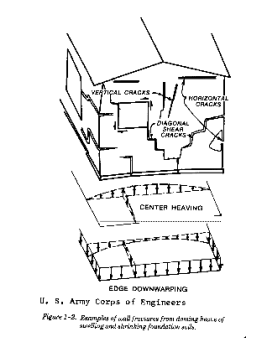
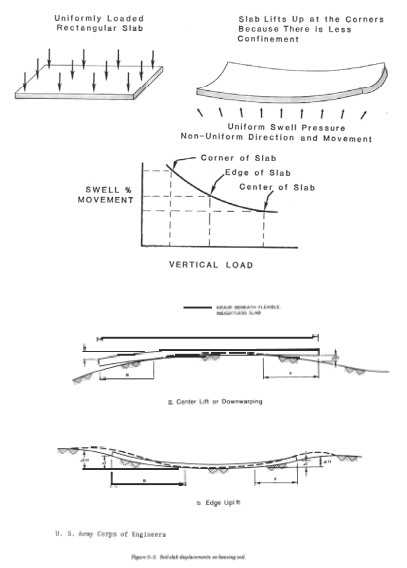
The figure above show cracking on light residential structures and deformations in lightly loaded roadway pavements due to center lift and edge uplift (Ref. 2.0).
7 DETECTION AND IDENTIFICATION OF SHRINK SWELL TENDENCY
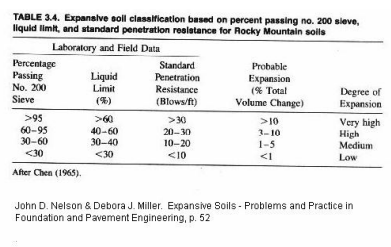
Detection of Swell tendency of soils is relatively simple and straightforward and normally relies on inexpensive laboratory tests that are part of the Soil Evaluation report. We refer specifically to the prevalence of SOIL INDEX TESTS such as the very well known “Atterberg Limits Tests” and grain size analyses to provide initial indication of expansive potential.
Oftentimes, more expensive tests may NOT even be needed during the early part such as the use of X-Ray Diffraction methods as well as Swell pressure tests. The Atterberg Limits are a telltale for expansive tendencies and numerous correlations with the Liquid Limit and the Plasticity Index as well as the Fine fractions (minus # 200 Sieve) have been published in literature to gage expansive potential of the soils.
But why are these tests NOT being used for this purpose? We believe that the reason is that Expansive potential is Not even recognized as a reality in a Tropical setting because most published literature about the subject always speak about occurrence of Expansive soils only in Arid Desert settings.
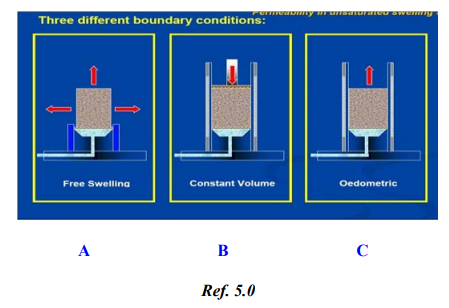
The figure below shows the various laboratory tests that could be undertaken to confirm the swell tendency of the soil by measurement of Volume change or Swell Pressure under confined conditions after the tendency has been initially identified.
The Figure “A” shows the free swell test where the soil specimen is allowed to swell in all directions under unconfined conditions in order to measure the magnitude of swelling that could occur under unrestrained conditions.
The test (Second Figure “B”) is to determine the swell pressure of a compacted specimen of soil under ZERO Volume Change or the constant Volume test. The Soil is saturated under the prescribed overburden and allowed to swell under lateral confinement. The heave is registered and the load is increased to return the soil to Zero Heave. The cycle is repeated until no further heaving is observed. The resulting load to return it to zero swell is the swell pressure.
In the Oedometer (Third Figure “C”) Swell Test, the Undisturbed or Compacted Specimen is Saturated and allowed to swell under increasing Load as in the regular consolidation Test. The amount of Swell is recorded as a % of the Specimen Height.
8 OUTLINE OF RESPONSE STRATEGIES BEFORE CONSTRUCTION
It would be far easier to avoid the problem brought about by swelling soils if this is recognized before construction is started rather than to undertake remediation when the problem has manifested itself. Thus a careful study of the area would be required in order to determine whether swelling would be a problem. This could be done by conducting simple reconnaissance of the surrounding areas to see whether cracking is manifested in the roadway pavements, fences and even the houses and by interviewing owners of adjacent properties. In addition, inexpensive soil index tests can be performed on suspect soils to determine whether the soil indices (LL & PI) as well as the Fine fractions (minus #200 Sieve) indicate swell potential or not.
The following are some of the response strategies that could be resorted to before construction, once the target site exhibits soils with swell tendency:
Removal of problem soils before construction
Typically, expansive soils have relatively shallow occurrences (to within 2.0 to 4.0 meters from the natural ground line (NGL) as the expansive alumina is concentrated by shallow leaching of the soils. However, there are also extensive deposits that are significantly thick and this would have to be ascertained. If the expansive soils are relatively thin, then removal would be the best solution to totally eliminate the problem. In case this is not possible, other solutions can be resorted to.
Elimination of source of water
Water triggers the expansion of swelling soils. The volume change is due to progressive adsorption and absorption of water. If water can be eliminated Totally (which would be at best difficult) then the problem is arrested. There is no clear cut and foolproof way of totally eliminating water under structures because of the infiltration of water from seasonal rainfall, from leakages in the domestic water system as well as the sewer system and due to Thermal Migration. Thus, this solution is NOT totally effective.
Maintainance of moisture equilibrium
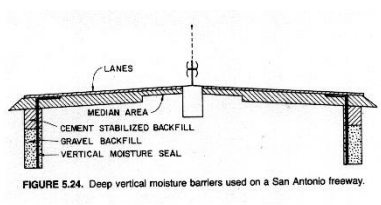
The Shrink Swell cycle occurs due to seasonal or cyclic changes in water content. If the Moisture equilibrium can be maintained, then the initial swell that has occurred will no longer progress and shrinkage is prevented by preventing exit of the water underneath the structure. The key is to preserve the moisture balance as a way to avoiding progressive and periodic volume changes. This is done by providing impermeable vertical barriers (HDPE or GCL) sufficiently deep to prevent moisture migration both ways.
The vertical Moisture barrier in the figure below can be any durable impermeable liner such as HDPE or Geosynthetic Clay Liner or plastic walls (Cement Bentonite liner).
HDPE Barrier Walls has be n used successfully by the authors in several projects.
Reduction of soil compaction and compacting wet of OMC (Prewetting).
Surprisingly, reduction of compaction density could reduce the total swell magnitude. This is done by compacting the soil wet of optimum and by prewetting. The resulting lowered soil density will reduce the rebound swell magnitude in much the same way that a coiled spring will rebound less if the precompression is reduced.
However, controlling the migration of moisture complicates this solution and therefore the latter has to also be addressed in conjunction with this solution.
Chemical treatment with quicklime, Portland Cement or other stabilizing agents.
The liquid Limit and the Plasticity Index of expansive soils stabilized with quicklime abruptly decreases which also indicates that the swell potential is significantly reduced. The quicklime chemically reacts with the soils and reduces the activity of the soil as well as providing bonding of the soil particles as to reduce the swell potential. Stabilization by quicklime also increased the overall strength of the stabilized soil.
Other chemical stabilizing agents are also available that could act on the expansive soils but these should be tested in the laboratory before being used in the problem.
Structural Responses
Structural responses are resorted to if the other procedures are impractical or not feasible. These are discussed in more detail in subsequent sections and should be used as a last resort to gage effectiveness.
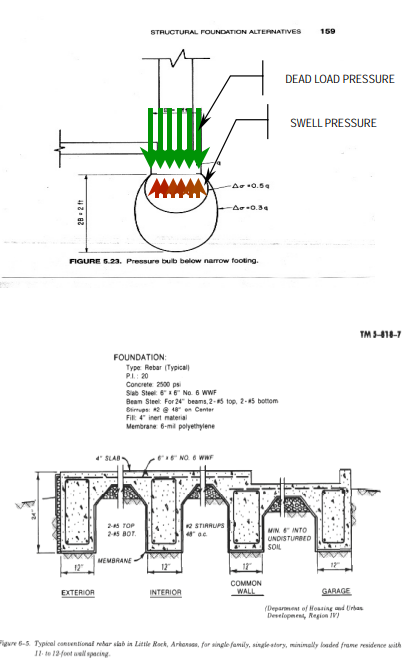
Countering the Swell Pressure Magnitude by Increasing the Intensity of Dead Load Contact Pressure
The contact pressure from the dead load is increased by reducing the footing contact area as shown diagrammatically below. The swell pressure has to be measured in the laboratory using the confined swell test or constant volume test to determine the maximum potential swell pressure that could be generated, simulating the actual density of the soil in-situ.
Thus, if the structural clement is heavier or larger than the swell pressure, no heaving would result.
The figure above (Ref. 2.0) illustrates the common procedure in increasing the deadweight contact pressure of the structure while at the same time making the slab stiffer. The Stiffened slab and Beam construction is designed to resist the swell pressure and the weigh of the structure is supported only as Line loads. Thus the deadweight effectively counteracts the Swell pressure.
A variation of this construction is by use of Post tensioned slab to further increase the stiffness.
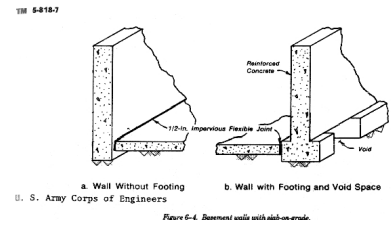
Another defensive construction uses walls without footings or footings with large gaps or voids to increase the contact pressure.
The Wall becomes the Bearing element without any footing to increase the counterweight or with a reduced footing Contact area with Void Spaces to relieve the swell Pressure and Funnel it into the Voids.
⦁ Use of Piling
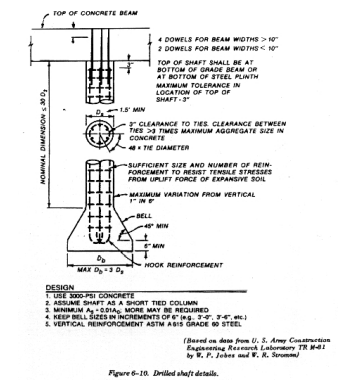
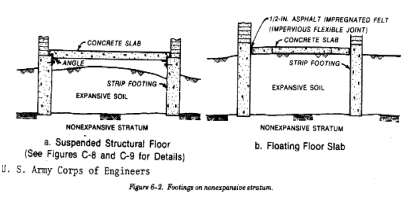
The use of piling to bypass the swelling soils and resist the swell uplift by anchoring the piles sufficiently or even with the use of belled bottoms is resorted to in extreme cases. The Floors are all structurally suspended on the piles so as not to be affected by the swell pressure.
The figure below illustrates the procedure: (Ref. 2.0)
The piles are often belled to increase the resistance against uplift.
⦁ Release of Floor slab
The floor slab is freed from any restraint and is removed from any contact with the swelling soil or the slab is totally free to move or “Float” with the swelling soil when heaving occurs.
9 RESPONSE AND REMEDIATION STRATEGIES FOR RESIDENTIAL BUILDING CONSTRUCTION
⦁ Swelling soils cause damage to thousands of homes every year.
The extent of the damage varies from cracked driveways and sidewalks to severe structural deformation.
Even well designed and constructed homes can be damaged if proper landscape installation and maintenance practices are not followed some precautions are necessary:
⦁ Don’t allow sprinkler systems to spray any closer than five feet from the foundation. And plant trees no closer than fifteen feet from the foundation.
⦁ It’s also important to carefully regulate water applied near the foundation. And avoid the temptation to remove downspout extensions to harvest water for flower beds near the house.
Also, avoid unlined plantboxes.
10 SUMMARY AND CONCLUSIONS
⦁ Potentially Swelling soils are Prevalent in our Country and must be recognized as a real problem.
⦁ The Reduction or Prevention of Damage is Relatively Easy and inexpensive if detected early before Construction through the conduct of simple Soil Laboratory Index Tests.
⦁ Once detected, the problem can be eliminated early on by removal as the swelling soils are relatively shallow in occurrence.
⦁ Remediation and repair of damage caused by swelling soils on the other hand is relatively very costly, difficult and disruptive and can be prevented if careful steps as above are taken before construction.
REFERENCES
1] Day, Robert W. Expansive Soil Foundation Movement. Foundation Engineering Handbook: Design and Construction with the 2006 International Building Code. 2] Department of the Army USA, Technical Manual TM 5-818-7. Foundations in Expansive Soils, 1 September 1983.
3] John D. Nelson and Debora J. Miller. Expansive Soils – Problems and Practice in Foundations and Pavement Engineering. Department of Civil Engineering, Colorado State University. 4] J.J. Hamilton. Canadian Building Digest, CBD-184. Foundations on Swelling or Shrinking Subsoils.
5] Jones, D.E. Jr. and W.G. Holtz. Expansive Soils – the Hidden Disaster, ASCE, Civil Engineering, August 1973, p. 49-51. 6] Williams, A.A.B. Discussion of the Prediction of Total Heave from Double Oedometer Test by J.E.B. Jennings and K. Knight. Transactions, South African Institution of Civil Engineers, Vol. 5, No. 6, 1958. 7] Bozozuk, M. and K.N. Burn. Vertical Ground Movements Near Elm Trees. Geotechnique, Vol. X, No. 1, March 1960, p.19-32. 8] Burn, K.N. House Settlements and Trees. Proceedings, National Conference on Urban Engineering Terrain Problems, May 1973. Associate Committee on Geotechnical Research, National Research Council of Canada, Division of Building Research, NRCC 13979 9] Bozozuk, M. Soil Shrinkage Damages Shallow Foundation at Ottawa. Engineering Journal, Vol. 45, No. 7, July 1962, p.33-37.
Note: This paper as well as some of the public domain references may be accessed electronically in PDF format at our website: www.pgatech.com.ph
1 Emilio M. Morales, MSCE took his Master of Science in Civil Engineering at Carnegie-Mellon University, Pittsburgh, PA. USA in 1980. He was employed as a Geotechnical Engineer at D’Appolonia Consulting Engineers. Currently, he is the Principal of EM²A Partners & Co. and concurrently serves as President for IGS Philippines, Chairman for the PICE Specialty Committee. He is a PhD Candidate at the Asian Institute of Technology, Bangkok, Thailand. 2 Mark K. Morales, MSc took his Master of Science in Civil Engineering at University of California – Berkeley, USA in 2004. He is the Technical Manager of Philippine Geoanalytics, Inc.
Emilio M. Morales CE, MSCE, F.ASCE, F.PICE, F.ASEP 1] Mark K. Morales CE, MSc 2]
ABSTRACT: Geophysical methods are generally non-invasive or non destructive methods long used in the construction industry for investigation of the subsurface. Principally, these are used for the detection of geologic anomalies such as cavities and voids, detection of buried pipes and other utilities, detection of water bearing aquifers for well development, exploitation of quarries and in determining soil stratification or layering. In addition, the methods provide a means for verifying as constructed pavement thicknesses in a continuous unbroken image of the pavement structural configuration or determining rebar embedment and layout non destructively.
The use of Geophysical methods confers advantages as they generally speed up the process of investigation, provide continuous streams of information not otherwise available in discrete sampling or invasive procedures and give advance information on what to expect for a given locality before a more detailed and costly soil exploration is even planned. Thus Geophysical methods are a force multiplier for the engineer and allow the user to identify potential problem areas or target areas even before the start of a detailed Soil Exploration program.
Geophysical methods are not a replacement to a detailed soil exploration program; rather they augment these programs to yield more meaningful and area extensive but more intensive information at the fraction of the time and cost.
The Paper discusses three general methods which have been employed by the authors in various projects. Case histories are discussed to highlight successful deployment of these methods in the Construction Industry.
1.0 INTRODUCTION
Geophysical Methods have been around for quite some time. These are non invasive procedures employed in order to determine subsurface soil conditions and geologic anomalies such as cavities and voids or buried objects such as pipelines. Geophysical methods are used for various purposes in Civil Engineering Investigation of the subsurface.
The advent of high speed computers and fast signal processors have vastly improved the technology and resulted in increased reliability and signal clarity in the use of these methods.
This Paper presents our local practical experience in the deployment of Geophysical methods and equipment to address and provide solutions to various practical problems3 where conventional approaches may not give adequate information or may not provide it in a faster or more accurate way. Although Geophysical methods address the need for more information compared to conventional borings, these are not substitute to actual soil borings particularly when soil design parameters (strength and compressibility) are needed. However, borings may provide only limited discrete information points or are limited because of budgetary restrictions while Geophysical methods may provide a continuous data stream or even three dimensional images of the desired target of interest. Thus these two methods are complementary and would provide a more meaningful information record when done together or when augmented by each other. Although again these methods are not a substitute for detailed borings except for specific objectives which do not require strength characterization or design strength or compressibility parameters, they can sometimes yield more meaningful results and thus corroborate results of other methods.
2.0 GROUND PENETRATING RADAR (GPR)
Ground Penetrating Radar Technology is an offshoot of the military use of radar and was spurred by the need to do research in the thick ice of the Polar Ice Cap4 which would be difficult to investigate continuously by borings. The developed technology is now used widespread in the construction and civil engineering profession but has now also reverted to military use again in the detection of buried mines (IED’s) and arms caches particularly in Iraq and Afghanistan.
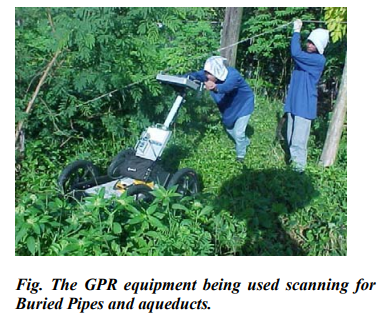
Electromagnetic radar impulses (EMP) are transmitted at a frequency of 100 to 200 kHz from the equipment and are bounced back or absorbed by objects depending on the material stiffness and saturation and other interferences. A receiving antenna receives the bounced signals or pulses and is processed by computer in Real Time to provide a computer image of the subsurface.
The choice of Ultra magnetic Impulse Frequency determines the effective depth for exploration. The Frequency is inversely proportional to the effective depth of exploration. Very high Frequencies are used for shallow depths such as for roadway pavement structure investigation where a continuous record of the pavement structural thickness to the nearest millimeter is desired for dispute resolution or for QA and audit purposes.
3.0 GPR APPLICATIONS
Used for detection of Cavities and Geologic Anomalies
Used for detection of Buried objects such as pipes, Improvised Explosive Devices (IED’s) mines, subsurface disturbances and Archeological artifacts
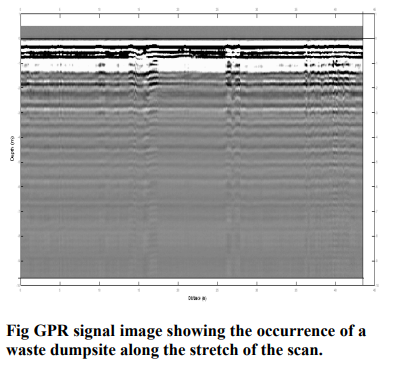
Used for environmental scanning to determine waste landfills
Used For determination of structural thickness of Roadways and pavements
Used for detection of Rebars and other embedded Objects in Concrete
4.0 INHERENT LIMITATIONS OF GPR
The presence of highly saturated plastic clays would tend to mask the radar signals and may produce no radar image at all or very hazy ones leading to some inaccuracies in the procedure. In addition, the presence of surface obstructions such as concrete pavements, the presence of subsurface boulders and other objects would tend to affect the accuracy of the signals and the images generated for low antenna frequencies.
In highly conductive zones, such as saturated montmorillonite clays or saline marshes, it is almost impossible to obtain useful results below 1-2 wave lengths of the antenna.5 However, the beauty of these different Geophysical methods is that the other individual procedures can complement for the weakness of the other. As in the above example, the inability to penetrate highly saturated clays can be overcome by augmenting this with the use of Seismic Refraction methods. Also, the weakness or inability of Seismic refraction methods to penetrate denser materials overlying softer or poorer layers is completely overcome with the use of GPR.
Therefore, the complete lineup of equipment could offer a comprehensive solution by overcoming inherent limitations of one method and augmenting this with the strength of another method.
5.0 GPR APPLICATION CASE STUDY
An Industrial complex was planned for construction. Subsequently, we were asked to undertake Geotechnical investigation with numerous borings. The Borings indicated to us the presence of what originally were suspected to be cavities in the karstic limestone formation in the area which are not uncommon in these formations.
Further studies and additional boreholes indicated that the cavities were interconnected and the alignment was correspondingly traced in the boring plan. Subsequent inquiries with adjacent property owners indicated that these were fortune hunting tunnels oriented towards the main facility. We requested additional confirmatory borings to trace the tunnel alignment as well as the suspected vertical access shaft which extended as deep as 25 meters below the NGL and which consisted of very loose to loose backfill material. This request was granted and six additional boreholes were made and confirmed the presence of tunnels in the area.
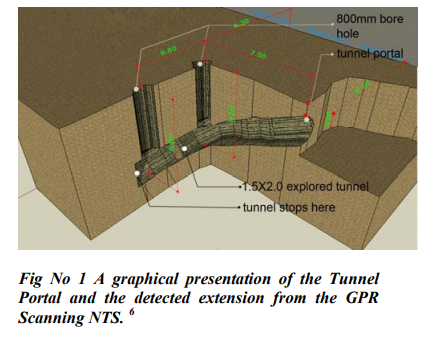
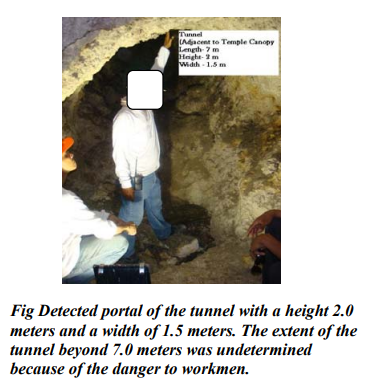
No attention was paid to it by the owners immediately due to the hectic schedule and because the tunnels were deep, until very late in the construction when a tunnel portal was detected during the excavation for a large diameter drainage line very close to the main building which was already completed.
We were requested to verify the extent of the anomaly by GPR.
Our investigation confirmed the original alignments of the “cavities” which turned out to be fortune hunting tunnels, burrowed under the main building footprint. It turned out that the site of the main building was the original Headquarters and residence of the commanding General of the Japanese Imperial Air Force overlooking a major airfield. The Tunnel alignments including the recent discoveries were plotted and subsequently verified by large diameter auger equipment.
What was detected coincided with our predictions as extrapolated from the initial soil borings.
GPR sweeps or scan lines were requested in areas under building footprints and were not required in the open areas. The GPR survey confirmed the initial results from borings and also extended the detected tunnel extensions beyond the initial influence areas of the previous borings.
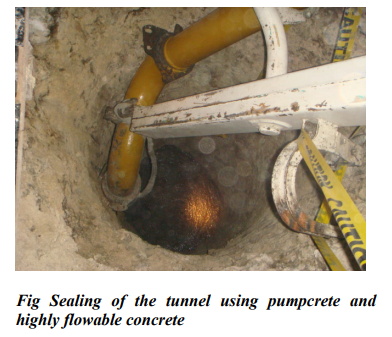
The tunnels were finally sealed by highly flowable concrete. In one area, it took 7 Transit mixer loads to seal one segment of the tunnel.
One other segment which collapsed could not show a positive indication but when the hole was pumped with water, the water intake was very significant.
Subsequently this segment was also sealed by highly flowable concrete.
6.0 SEISMIC REFRACTION METHODS
Seismic refraction consists of sending shock waves into the soil either by use of hammer striking a steel plate or with the use of explosives.
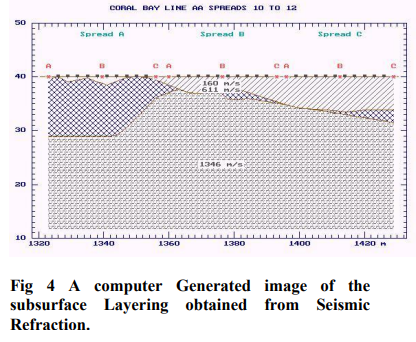
The vibrations induced are picked up by a Seismograph through an array of geophones which pick up the refracted and reflected signals. The velocity and travel time for these shock waves through materials with varying material stiffnesses are measured and the refracted and reflected signals are processed by an on board computer, as they travel to various media .
A Seismic Refraction Layout is typically known as a “Spread”. Each spread consists of 12 to 24 Geophones as used in shallow engineering surveys.
A “shot” is an initiation of a shock wave into the surface of the soil to initiate the recording of the arrival times of the shock waves at various Geophone locations. Each shot would provide information of the underlying soils under typical conditions. Several shots are needed to ensure that geologic anomalies are detected such as sloping bedrock, faulting, presence of cavities etc.
A typical spread would require a minimum of five “shots “ to determine the characteristic stratification of the subsoil and the underlying physical properties in terms of Seismic Velocities.
7.0 CASE STUDY APPLICATION OF SEISMIC REFRACTION
An industrial complex wanted to expand on an adjacent elevated hill beside the Refinery. The new expansion of the plant will require a massive cut on this hill including through the bedrock.
The depth to bedrock is known to be Highly variable and it would be required to plot the exact profile of the Bedrock at close parallel offsets in order to draw an accurate bedrock contour and quantify hard rock excavation. Due to the variable depth, volume of hard rock excavation cannot be accurately determined. It was estimated by the client that to do so using conventional subsurface investigation methods would involve at least 30 borings and would take 65 days to complete.
An accurate Bedrock contour is needed to quantify hard rock excavation, which need to be blasted by explosives.
Because of the large area involved, numerous boreholes would need to be drilled to characterize the bedrock contour. This would be very expensive and the time involved would delay earthmoving and hard rock excavations as the equipment were already mobilized. Seismic Refraction was requested and five Parallel lines consisting of 13 spreads each at 20 meter parallel offset lines were done. The complete operation was completed in one week and an additional week was needed for data reduction and interpretation in the office.
As a result, the bedrock contour was accurately delineated resulting in more accurate estimates of the cost as well as reduction in time to Project completion. As another added benefit, some of the week layers (lower velocity layers) were detected which would be amenable to ripping rather than blasting.
8.0 GEORESISTIVITY METHODS
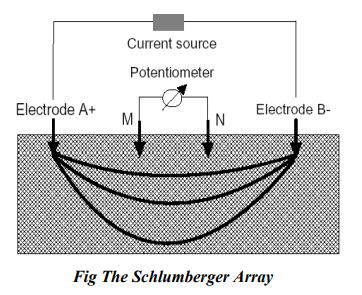
Georesistivity methods fall into the category of Vertical Electrical Surveys which sends electrical current into the subsurface. The resulting electrical resistivities are then measured and correlated and compared with various soil types and water bearing aquifers to yield layering or stratification information as well as identify other layer properties. Two commonly used methods are the Schlumberger
Electrode array (Shown below) and the Wenner Electrode array. The former method is more popular for use in well or aquifer surveys.
The Schlumberger Method 7
The Schlumberger array uses four electrodes: two of which serve as the current electrodes and the other two for potential electrodes. The current electrodes are represented by AB and the potential electrodes by MN. Electric current is introduced into the ground using AB electrodes and the potential difference is read using the MN electrodes. Initially, lengths of AB and MN are set to two meters and one meter, respectively. As the measurement progresses, AB expands from the sounding center at the spacing interval of factor of square root of two, i.e., 1, 1.4, 2, 2.8, etc., keeping the MN constant. However, as the length AB increases, electrical voltage drops considerably. The manufacturer of the instrument has prescribed a minimum voltage of five millivolts when conducting resistivity measurements. To keep voltage above the set minimum voltage, MN has to be expanded as well. In order to detect discrepancy for the reading when MN is expanded to a new length, duplicate readings are taken for the same AB but with different MN values.
Readings from the instrument are raw resistivity data. Actually, they are in the form of volt/current ratio, having a unit of “ohm”. These resistivity raw data are multiplied by a geometric factor unique for every set of AB and MN which is taken from the formula:
The resulting values when the readings are multiplied by this factor will now be the apparent resistivity. The usual field procedure is to plot the computed apparent resistivity at logarithmic scale paper to gain initial view of the resulting curve. This is undertaken prior to interpretation or at the sounding site to preclude unwanted curve, which results when errors are committed in readings and in distances set up.
The interpretation of the measured values is facilitated through the use of a built in computer software and signal processor within the instrument. Resistivity sounding interpretation software was used for database management and sounding interpretation including plotting of sounding curves.
9.0 CASE STUDY APPLICATION OF GEORESISTIVITY
An industrial plant had to boost groundwater capacity as the existing wells are proving inadequate.
It was originally suspected that the Existing wells would not meet future demands of the Factory.
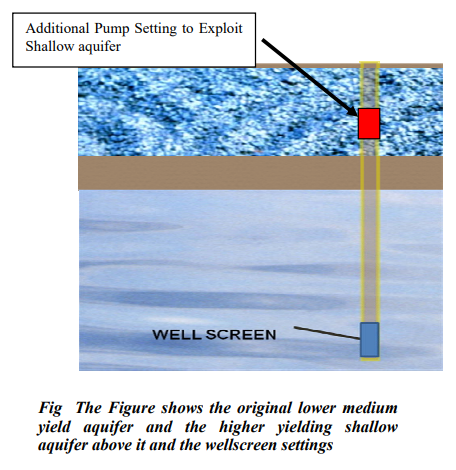
The four production deepwells were barely adequate to meet the demands of the manufacturing facility although the deepwells are spaced far apart and not competing with each other. The wellscreens were set at the middle of a deep medium yield aquifer at approximately 200 meters below existing NGL.
The site was subjected to Vertical Electrical Survey (VES) using an Electric Georesistivity Equipment.
The results were very surprising, as the VES pointed to a shallow but otherwise very promising aquifer which was consistently bypassed by the previous deep wells drilled and resulted in a new program for Groundwater development to exploit the shallow aquifer which has remained an untapped groundwater resource.
The results of the VES pointed to a very promising highly permeable and very shallow water bearing layer which has been consistently bypassed in all the existing well developments. This shallow aquifer can increase the yield from these existing deep wells by using two well screen settings instead of one by at least 2.5 X.
Future well settings will concentrate on this shallow aquifer for major development.
The direction points to exploitation of this aquifer layer as well as the lower aquifer with a new well.
The potential total yield is around 50 to 70 cu meters per hour which could significantly boost the future water demand in conjunction with the other wells.
We do not expect significant impacts on the lower aquifer in terms of potential yield when exploiting the upper aquifer as the latter is separated by an impermeable clay layer or an aquiclude.
10.0 SUMMARY OF CONCLUSIONS
The usefulness of Geophysical methods has been demonstrated by several case studies.
It is expected that greater awareness by the Engineering Community will lead to increased deployment of these methods to solve Civil Engineering and other problems involving the subsurface.
The three methods discussed are in themselves complementary to each other and the limitations in one could be reinforced or strengthened by the other methods providing a full arsenal of procedures to effectively obtain cost effective and more meaningful results of subsurface anomalies and properties.
The Geophysical methods are not intended to supplant borings except in specific cases where information gathered would be sufficient to address the intended purpose/s. It is hoped that through these practical sample applications, a better appreciation of the capabilities and cost effectiveness of each method can be understood better by the engineering community.
1 Principal, EM2A Partners, MS in Civil Engineering, Carnegie-Mellon University, Pittsburgh, PA. Fellow PICE, ASEP and ASCE, PhD Candidate Asian Institute of Technology, Bangkok Thailand, Formerly Senior Lecturer, UP Graduate Division, School of Civil Engineering, Diliman. 2 Managing Director, Philippine Geoanalytics Inc., Master of Science, University of California, Berkeley, Berkeley Ca., President PGA Earth Structure Solutions Inc., Lecturer, Mapua Institute of Technology, Department of Civil Engineering, Intramuros, Manila.
3 In all the practical case studies, the name/s of the project and the clients cannot be mentioned due to confidentiality issues. Project description and locations have been altered somewhat so as not to identify the Sources. Where credit is due, we apologize to the sources as we cannot name them.
4 Internet download
5 SEGJ. “Application of Geophysical Methods to Engineering and Environmental Problems”. Advisory Committee on Standardization, The Society for Exploration Geophysicists of Japan, 2004.
6 Computer graphics representation courtesy of client (un named).
Synopsis: The Tensile Stress (TS) and Yield Stress (YS) of rebars are the primary reference material properties and control used by the Structural Design Engineer in his design to assure that reinforced concrete members behave in a manner assumed and predicted by Reinforced Concrete Design Theory and Practice.
Almost unclear to the Engineering community is the significance of the relationship between these two values which is expressed as the TS/YS ratio.
Although the ACI Code and most international codes pertaining to Reinforced Concrete Design in Earthquake Zones, such as the UBC specify that the TS/YS ratio shall not be less than 1.25, its significance to the Design Engineer and the project manager is obscured by the focus given on the Tensile Strength and Yield Strength individually.
It is the objective of this paper to explain the critical importance of considering the TS/YS ratio and for the engineering community to understand the importance of maintaining this ratio to 1.25 or greater.
In the quest for globalization of commerce, there is a trend towards adoption of ISO Standards in the interest of “rationalization” and Fair Trade. The local committee TC-11 formed by the BPS is in the forefront of ensuring that these standards are geared to suit local conditions. Nowhere is this more important than in the issue of the TS/YS ratio for rebars which is undergoing revision. A better understanding of this issue would aid in assuring that our standards such as PNS 49 for rebars are responsive to and suited to our high Seismic Hazards and that the TS/YS ratio should be maintained.
1. INTRODUCTION
The design of reinforced concrete structures in seismically active regions require special considerations unique to this kind of exposure. Particularly in the Philippines, which has a very high seismic risk, attention to detailing of reinforced concrete takes on a very important meaning and is of high priority to the Design Engineer.
Due to the narrow focus on test results, more specifically on the individual Tensile Strength (TS) and Yield Strength (YS) of reinforcing bars, the critical relationship between the two properties expressed as the ratio TS/YS is oftentimes lost to the Design Engineer and the Construction Manager.
Worse, due to inattention or plain ignorance, higher strength reinforcing bars than originally intended in the design are passed on or accepted without realizing the dire consequences related to such actions.
More often than not, when the Engineer reviews the test results on reinforcing bars submitted by the contractor or the Independent Laboratory, he/she merely looks at these values and checks whether they meet or exceed the specified code minimum. Being satisfied that this is so, the Engineer then accepts the materials for use in the Building. In some instances this may suffice, by chance but there are many occasions where such cursory checks are not enough. It is necessary to ensure that the TS/YS Ratio satisfy the requirement contained in Subsection 5.21.2.5.1 of the National Structural Code of the Philippines and the ACI Code as it pertains to Earthquake Resistant Design.
This subsection reads:
“5.21.2.5.1 Reinforcement resisting earthquake induced axial forces in frame members and in wall boundary members shall comply with ASTM A-706 PNS 49. Grades 275 and 415 reinforcement are allowed in these members if (a) the actual yield strength based on mill tests does not exceed the specified yield strength by more than 120 MPa (retests shall not exceed this value by more than an additional 20 MPa) and (b) the ratio of the actual Ultimate Tensile Stress to the actual yield stress is not less than 1.25.”
At first glance, the above requirements may seem baffling, for why should there be a ceiling cap placed on the yield stress? Why are the steel Grades limited to PNS Grades 275 and 415 for Seismic Design? Isn’t stronger necessarily better? Also, why should there be a mandatory minimum value of 1.25 applied on the Tensile Stress to Yield Stress ratio.
Clearly, there is a need for an explanation. This explanation is conveniently and clearly found in the commentary of ACI 318 R-95 most specifically commentary R 21.25. (See Appendix “A”)
However, as stated earlier, the importance of these provisions and the reasons behind it are obscured or lost or relegated to the background.
To confound this issue, there is a move to realign our standards with that of the world, mainly thru adoption of ISO Standards in keeping with liberalization of trade and elimination of barriers to trade.
Present ISO standards, the so called EUROCODES require a TS/YS ratio of 1.05 and 1.08 which is very much below the ratio 1.25 given in our present NSCP Code and PNS 49.
Tests conducted in Italy, Macchi (1996) which is also a seismically active region, indicate that these values are inadequate to ensure ductility under simulated earthquake loading.
The Bureau of Product Standards TC 11 – Committee or Steel Products (of which the author is a member) is at the forefront of this activity. Representation by ASEP in this committee will help to preserve the existing TS/YS ratio of 1.25.
In addition, the engineering community should insist that the TS/YS ratio be published on all mill certificates and laboratory test results to ensure that this requirement is amply satisfied and the end user properly informed.
It is the purpose of this paper to expound on these requirements in the hope that a greater understanding of these provisions would result in giving these due importance and attention that these deserve.
2. PRACTICAL AND THEORETICAL CONCEPTS
In order to understand the foregoing issues at hand, we would need to review and/or understand some very critical aspects related to seismic design.
2.1 Stress Strain Behavior of Steel Reinforcing bars in Uniaxial Tension
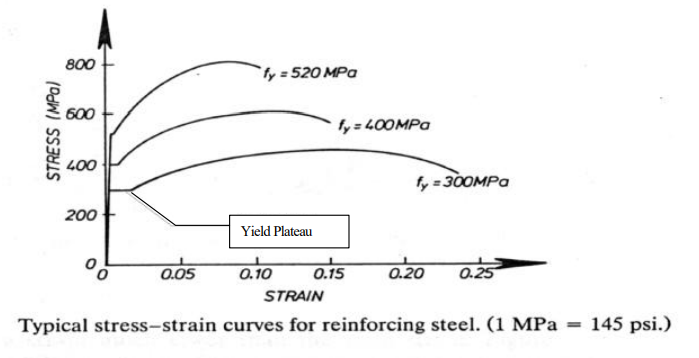
Steel behaves as a linearly elastic material within the elastic limit (stress is directly proportional to strain) until yielding occurs. Beyond this point and prior to ultimate failure, stress is no longer proportional to strain. However, considerable strength development after a yield plateau is developed, occurs (although non-linear) prior to failure.
This region is known as the strain hardening region where further strength gain results due to proportionately larger strains imposed. Beyond the strain hardening region, further straining results in strain softening until failure occurs. The peak stress is considered the ultimate stress.
The typical curve shown below is taken from (Paulay and Priestley, 1992):
The above typical stress strain curves indicate that ultimate strain and the length of the yield plateau decrease as the yield strength increases. This development is not at all desirable because the steel stress that may develop in a section may greatly exceed the yield stress leading to shear failures or unexpected flexural hinging. It would be therefore desirable to limit the steel grades used as indicated by NSCP 5.21.2.5.1.
2.2 Ductility Versus Brittleness
The term ductility refers to the ability of a member to undergo large deformations without rupture as failure is occurring. Ductile members could therefore bend and deform excessively but they remain intact. This essential capability of properly designed and detailed RC members ensures against total structure collapse and provides protection to building occupants at the critical instant when failure is occurring. Brittle members on the other hand fail suddenly and completely with very little warning. This sudden failure may damage adjacent elements or overload other portions leading to progressive total collapse.
Ductility includes the ability to survive large deformations and a capacity to absorb energy by hysteritic behavior. For this reason, it is the single most important property sought by the designer of buildings located in regions of high seismicity. It is therefore necessary to ensure ductility of members to allow visible development of large deformations before total collapse occurs, thus providing ample warning to occupants.
While ductility is assumed by proper seismic detailing provision, it is equally important to ensure that the reinforcing bars behave as intended by maintaining a cap on the yield stress and by ensuring that the TS/YS ratio is > =1.25.
In general, seismic forces that could be developed in a structure during a seismic event decrease with increasing ductility. However, the amount of ductility permissible may be a function of acceptable deformation magnitudes.
2.3 Structure Stiffness
The structural response of structures to earthquakes is dependent on the relative stiffness of the system, the ability of the system to dissipate energy and the inherent ductility of the system.
A rigid structure will attract load during an earthquake; more flexible structures will develop smaller seismic forces. However, the degree of flexibility that may be acceptable is limited by the effects of large lateral displacements resulting from flexibility (Kinitzsky et al 1993).
2.4 Reinforcement Percentage
The amount of steel reinforcement commonly expressed as a percentage of area of steel to concrete is important in Reinforced Concrete Design and more so in seismic resistance of RC Structures.
In an over reinforced flexural member (large steel percentage) the failure mode is brittle. This is because crushing failure of concrete is reached before yielding of the reinforcement occurs.
The same failure mode is realized in an under reinforced beam. When the tensile stress of the limited steel area is reached, the modulus of rupture of concrete is exceeded causing the concrete to crack and immediately release this load on the steel reinforcement. If the steel area is too small to carry this force, the rebar will snap and cause sudden failure.
Ideally the only desirable mode of failure, a ductile one, can be induced by moderate percentage of steel. This failure is initiated by gradual yielding of the steel while concrete strains are still relatively low. Thus, large deflection are attained before final collapse occurs Leet (1991).
From the foregoing concepts, the following conclusions could be made:
Ductile behavior should be assured through careful material selection, design and detailing.
Some flexibility in the structure is needed to reduce seismic forces through energy absorption and dissipation.
Moderate levels of reinforcement should be used to assure ductile behavior.
3. THE TS/YS RATIO AND ITS IMPORTANCE
There have been many occasions in the past where overstrength reinforcing bars (Higher Yield and/or Higher Tensile Strength) are innocently accepted by the Design Engineer or passed on by the supplier as the specified grade in the mistaken belief that stronger is necessarily better. Sometimes higher grade steels failing to meet the specs are downgraded and used as lower grade reinforcing bars.
In another previous paper by this author Morales (1997) this matter had been brought to the attention of the Engineering community. However, it was felt, due to the ongoing deliberations on trade liberalization and rationalization that this issue be delved with in more detail so that its implications could be fully understood.
In some occasions too, the Engineer does not even see the test results and relies on his Junior Engineer to monitor them. The Junior Engineer, lacking in experience and knowledge upon seeing that the test results are greater than the specified, reports that everything is well and so the problem does not get attended to until it is too late.
These real life examples bring to fore the need to understand the important of the TS/YS ratio and why greater attention should be given to test results. Let us now discuss the technical issues involved and its effect on our structures.
3.1.1 Yield Strength (YS)
The NSCP, which also echoes the requirements set forth in ACI 318 and the Uniform Building Code of the USA, sets a cap or limit to the Yield Strength of Reinforcing bars. More specifically it requires that:
“a) The actual yield strength based on mill tests does not exceed the specified yield strength by more than 120 MPa (retests shall not exceed this value by more than 20 MPa).”
Definitely, there must be a reason behind this requirement.
A very much higher yield strength than that nominally assumed in the design is fraught with problems.
A higher yield stress will: Paulay (1992)
Induce higher concentrations of shear and bond stresses at time of development of the yield moments during seismic loading. Shear and bond type failures are explosive and brittle modes of failure and should therefore be avoided.
Attract larger lateral forces as a rule because energy absorption initiated at yielding or partial yielding is postponed and thus higher seismic inertia forces are generated further complicating the problem.
Prevent the formation of an extended yield plateau which is undesirable. An extended or longer yield plateau is desirable and stems from requirements of capacity design. It is necessary that the shear strength of all elements and flexural strength of sections not intended as plastic hinges should exceed the forces corresponding to development of flexural overstrength at the designated plastic hinge locations. If the rebar exhibits early and rapid strain hardening, the steel stress at a section with higher ductility may exceed the yield stress by an excessive margin.
If there is considerable variation in the yield strength, the actual flexural strength of a plastic hinge may greatly exceed the intended value postponing its formation until more critical loading is sustained.
3.1.2 Tensile Strength (TS)
Higher Tensile Strengths invariably means increased Brittleness. This is indicated by a reduced yield plateau and a very limited strain hardening region. This means that the yield region and its capacity to absorb energy through inelastic deformation is severely limited. In addition, the use of higher Tensile Strengths if unanticipated in the design could also correspondingly elevate the yield stress leading to problems stated earlier in the discussions on the implication of a higher Yield Stress (YS).
For this reason, the NSCP and the source codes (ACI 318 and UBC) limit the allowable steel grades for use in seismic regions.
3.1.3 The Ratio TS/YS
The unique material strength properties TS & YS are individually important to consider and control as they influence the behavior of structures during seismic excitation as discussed earlier.
Taken together as the Ratio TS/YS (known as the “Strain Hardening Value” in European practice), it indicates the ductility capacity of the structural member or component where it was used.
The larger this ratio, the better for the structure.
A large TS/YS ratio means a greater energy absorption capability before failure. In addition, larger deformations are experienced which could serve as visible warning to building occupants prior to total failure or collapse.
Less Brittle behavior therefore is experienced.
Professor Giorgio Macchi of the University of Pavia, Italy conducted experimental tests to determine the effect of the strain Hardening Value TS/YS on the performance of full scale RC columns subjected to Lateral Loads with or without axial loads. His findings contained in his published report “Ductility Requirements for Reinforcement under EuroCodes “ Macchi (1996) revealed very interesting findings which underscored the necessity of maintaining a high TS/YS value or the Strain Hardening Value .
We summarize his findings contained in this report:
Details incorporating relatively low TS/YS ratios (<<1.25) showed that concentrations of Plastic strains are in a very limited vertical region of the test specimens. As a consequence, the very high local curvature was necessary for the required displacement causing considerable local deterioration and premature damage. This led to destruction of the concrete cover. The lack of confinement of the concrete cover allowed the bars in compression to buckle. The bars then failed in tension under reverse action.
Reinforcing bars with TS/YS ratio of 1.4, as used in the tests, showed that plastic deformation spread over a considerable length along the specimen because of the high strain hardening value . Local curvature was smaller, the concrete cover remained intact and the bars did not fail. The RC member, therefore sustained higher top displacement.
Insufficient strain hardening leads to high concentrations of strain.
Insufficient steel elongation initiates earlier steel fracture at ultimate loads.
There should be a cap or limitation on overstrength of reinforcing bars.
4. EFFECT OF BOND STRENGTH ON FLEXURAL DUCTILITY
There have been concerns expressed earlier Cairns (1994) that improvements in the stiffness of bond force-slip relationship of reinforcing bars resulting from increases in the relative rib area of deformations may have a negative impact on the flexural rotation capacity (flexural ductility) of RC Beams. Similarly, there have been discussions in Europe aimed at reducing the relative rib area of reinforcing bars to improve Ductility.
Tests conducted by (Tholen and Darwin, 1995) have shown that a relatively large change in relative area has no measurable effect on the distribution of flexural cracks or on the displacement and rotational capacity of beams in which plastic hinges develop. Concerns on either point have been proven to be not justified.
The foregoing has been included if only to underscore the critical importance of the TS/YS ratio in assuring ductility, as any influence, no matter how it may seem insignificant to the uninformed, is being looked into by the engineering community to assure that ductility is enhanced and not diminished.
5. CONCLUSIONS
This paper has focused on the need to look into the importance of assuring ductility of RC structures not only through proper and adequate seismic detailing but also by proper understanding and selection of Material properties. Of these, it is necessary to ensure that Reinforcing bars used in the structure meet the requirements of NSCP Subsection 5.21.2.5.1 particularly as it applies to a cap on the Yield strength and the prescribed minimum TS/YS ratio of 1.25 . This paper also reiterates the need to erase the misconception that higher strengths invariably mean stronger structures.
The specified minimum TS/YS ratio of 1.25 helps to impart ductility to structures by:
Assuring that significant energy absorption and dissipation occur during inelastic deformation.
Preventing the premature failure of reinforcing bars due to brittle behavior.
Guaranteeing that plastic hinging develops at intended locations.
Avoiding premature failure due to strain concentrations.
REFERENCES
ASEP (1992) National Structural Code of the Philippines Volume 1. Association of Structural Engineers of the Philippines (ASEP), Manila.
ACI (1996) ACI Manual of Concrete Practice Part 3. American Concrete Institute (ACI), Farmington Hills, Michigan.
Paulay, T . and Priestley, M.J.N. (1992) Seismic Design of Reinforced Concrete and Masonry Buildings, pp. 114. John Wiley & Sons, Inc., U.S.A.
Krinitzsky, E.L., Gould, J.P. and Edinger, P.H. (1993) Fundamentals of Earthquake Resistant Construction, pp. 203. John Wiley & Sons, Inc., U.S.A.
Leet, K. (1991) Reinforced Concrete Design, Second Edition, pp. 84-95. McGraw- Hill, Inc. , Singapore.
Tholen and Darwin “Effect of Reinforcing Bar Deformation Pattern on Flexural Ductility”. ACI Structural Journal, V95 No. 1 January 1998 pp. 37-41.
Macchi, G. (1996) “Ductility Requirements for Reinforcement Under Euro Codes”. Structural Engineering International, April 1996.
Morales, E.M. (1997) Seventh International Convention on Structural Engineering: Facing the Challenge of Economic Growth “Stronger is Not Necessarily Better – The Significance of Tests and Properties of Civil Engineering Materials”. Manila Midtown Hotel, Pedro Gil cor. M. Adriatico Street, Ermita, Manila
ABOUT THE AUTHOR
Emilio M. Morales, MSCE took up his masters degree at the Carnegie Institute of Technology, Carnegie-Mellon University, Pittsburgh, PA. USA in 1980. Formerly Senior Lecturer of Graduate Division, College of Engineering, University of the Philippines, Diliman, Quezon City. Presently, he is the Technical Manager of Philippine Geoanalytics, Inc., Civil Engineering Laboratory and Principal of EM2A & Partners & Company. Committee Member, TC-11, Bureau of Product Standards Technical Committee on Steel Products.
He can be contacted at: EM2A Partners & Co., No. 17 Scout de Guia corner Scout Reyes Streets, Diliman, Quezon City. Telephone Nos. 371-18-04 & 06/ 410-29-23. Fax No. 3744338; E-mail: em2apart@pgatech.com.ph.
Emilio M. Morales, CE, MSCE, F.ASCE, F.PICE, F.ASEP 1]
Abstract : The application of Soil Mechanics principles in day to day construction practice involves an appreciation and keen understanding of soil properties and soil behavior in order to provide adequate and cost effective solutions. Oftentimes, the fundamental understanding of soil behavior and how to apply it to advantage is lost leading to costly mistakes and time delays. This paper aims to unify Soil Mechanics principles and Fundamental knowledge to the solution of construction problems involving earthworks and foundation. Further reading is recommended as this paper in no way can claim to be complete in defining soil behavior and the various factors influencing its properties and behavior.
The Construction professional is oftentimes confronted by seemingly puzzling problems in construction defying solutions. These problems particularly occur during earthworks or foundation construction. Unlike the construction of the superstructure where the professional is familiar with the properties and behavior of man-made construction materials, working with the soil is often times fraught with uncertainties and sometimes with the unknown behavior of soils and rocks.
These uncertainties happen due to various factors that are not known immediately because soil is a natural material and has varying characteristic properties and behavior depending on a myriad of factors which need to be understood.
The following are some of the factors that have a likely effect on the final soil behavior or characteristic property:
Soil or Rock Mineralogy
Manner of Physical Deposition
Presence or absence of Water
Effect of Physical forces acting on it such as load history or Disturbances from Vibration etc.
We shall also discuss the Problems and solutions that are influenced by the foregoing factors and some, by citing various experiences encountered in normal day to day construction activities.
2 SOIL OR ROCK MINERALOGY
2.1 Soil as a Particulate Material
Under a very powerful electron Microscope, even a piece of seemingly solid mass of clay appears as an assemblage of particles with some orientation. This orientation surprisingly can be altered by reworking of the clay, addition of or removal of moisture or by altering the chemical make- up of the porewater.
Under normal conditions, it would also be noted that the assemblage includes water and air. The water is either captured or adsorbed water or free water.
The process of compaction is nothing but the expulsion of air (reduction of voids in the soil). Thus, our attention is directed as to how this could be most efficiently done.
However, as we know, this assemblage that we just saw in the Electron Microscope is only but one of two major assemblages that soil can assume depending on its granulometry or Grain Size.
Soil can either be:
Coarse Grained (Sand) or Cohesionless
Fine Grained (clay) or Cohesive
The clear distinction between the two are somewhat obscured by their combinations or mixtures that could be found in nature. In their unadulterated states, the differences become readily apparent or clearly distinguishable.
2.2 Clay Microstructure
Let us now peer again at our microscope to look at a sample of cohesive or fine grained clay soil.
As we can see, the clay is composed of submicroscopic platelets surrounded by Electrical charges, a closely held layer of adsorbed water and an outer layer of loosely held water. The interparticle distances, measured in Angstroms Ǻ are governed not only by the particle orientation but also by the Electrical forces of attraction as well as the thickness of the adsorbed and free water. It would take a very high input of energy in order to dislodge or remove the adsorbed layer. However, the loosely held water can be removed in the field by sample air drying or windrowing or application of pressure. Once the free water is removed, compaction can be attained. These electrochemical forces give the clay its characteristic strength known as Cohesion. The particle orientation as we shall see in the succeeding table also affects some other physical performance characteristics of the soil.
2.3 Microstructure of Fine Grained Soils
Fine Grained Soils, because of their sub microscopic size are influenced by Electrical and Chemical forces of attraction and repulsion. This is due to the fact that the ratio of specific surface area to their volume is so large that surface electrical activity greatly influences the behavior of fine grained soils.
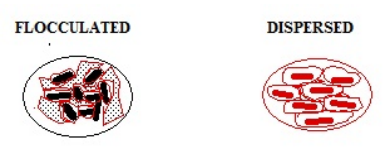
In nature, fine grained soils assume a flocculated or dispersed configuration as shown below depending on the manner of deposition and environmental influences that it has been subjected to.
A flocculated structure assumes a random tip to side orientation much like a “house of cards” whereas a dispersed structure has the platelets more or less aligned to each other.
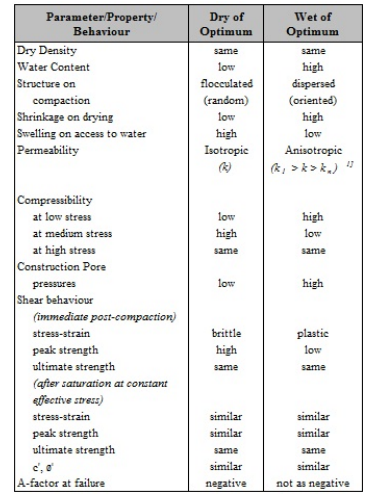
The arrangement of these platelets alone has an influence on the performance and behavior characteristics of the soil.
2.4 Sand Particles
Obviously we do not need a microscope to be able to see the coarser granular structure of sandy soils. In fact this can be done with the naked eye.
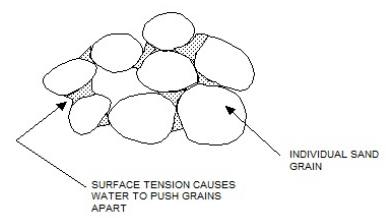
Very dry sand in the hand cannot be squeezed into shape whereas semi moist sand when squeezed could hold some shape until it dries out and crumbles. Surprisingly, addition of more water to saturate the sand collapses the sand as in the very dry state. Sand lacks real Cohesion and is therefore termed Cohesionless soils. It derives its strength in nature through interparticle friction and grain to grain contact stresses. Sands are therefore friction type materials with a Phi Angle Ǿ to define its characteristic resistance to shearing or sliding. However, this property is not a unique value and would depend on the state of the grain to grain contact arrangement as well as the normal forces that are providing the stress and confinement.
Sand when unconfined and loosely dumped assumes an angle of repose which would correspond to approximately its lowest Phi Angle Ǿ value.
2.5 Behavior of Highly Fractured and/or Jointed Rocks
A special case of a particulate behavior is highly fractured rock. Although it may appear intact and solid when exposed, highly fractured rock can behave as a particulate material when disturbed. Therefore, care in understanding the actual condition of rock is important particularly when making large open cuts in it.
Other than the jointing of the rocks, the dip or inclination of the bedding plane could also sometimes trigger instability in rocks when exposed in cuts simply due to the forces of gravity acting on the Particulate rock mass. Thus, care is necessary in trying to predict the actual behavior of rocks whether it will behave as a solid mass or as a particulate material. Otherwise, disasters can happen such as in the Cherry Hills Landslide.
3 MANNER OF PHYSICAL DEPOSITION IN NATURE OR PLACEMENT IN FILLS
The manner of deposition also influences the physical behavior of soils particularly for sands but also for clays. Whether laid gently or violently by agents of deposition such as water or wind, the soil behaves in accordance with the final state when deposited.
3.1 Effect of Natural Agents of Deposition
3.1.1 Deposition of Sand in Nature (Water Laid)
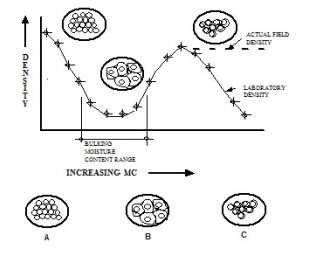
When grains of dry sand are gently deposited in a container, they fall into place in a precarious grain to grain contact. A jarring motion imparted on the container causes the grains of sand to assume a denser packing. Slight addition of water causes the sand to swell or increase in bulk while saturation with just enough water that is somehow allowed to drain causes the sand to be compacted into a dense state. This has been known to us since time immemorial as Hydrocompaction. This knowledge of Hydrocompaction is used for the compaction of clean sands in construction and we shall see why this is so. Perhaps only the mechanism behind it is not well understood.
3.2 Effect of Compactive Effort
Having recognized the behavioral characteristics of soils (Particulate Material) we now look at the means to achieve compaction in the Field.
However, try to remember the fundamental response of the two general types of soils to compactive effort.
Loose Clean Granular Soils, because of their precarious grain to grain contacts, are best compacted by causing a jarring motion or vibration such as what a vibratory roller would impart. In addition, saturating the sands immediately before compaction allows for increased compaction effectiveness.
Fine Grained Clay Soils; on the other hand respond better to a kneading type of compactive effort such as that imparted by sheepsfoot rollers and pneumatic type rollers as these tend to reorient the platelets. Clays are best compacted by a kneading motion say from a Static sheep’s foot or tamper foot roller with a controlled Moisture content very near or at the Optimum Moisture Content.
We can therefore see the effective ranges for various compaction equipment under differing soil conditions and we recognize right away that this has something to do with the grain size (clay to rock).
At first glance, it could be said that this is a very familiar and well accepted practice.
4 SOIL SHEAR STRENGTH
4.1 Clays
Particulate materials derive their strength from friction or intergranular contact and/or from bonding forces or cohesion as we know it. These bounding forces and friction prevent the particles from sliding.
The most important soil strength property that we have to deal with is the soil’s Shear Strength or Cohesion since most of the loading that the soil is subjected to causes the individual soil particles to slide or “shear” one against the other because of their very fine particulate character.
Depending on the granulometry of the soil and its moisture content, the shear strength is either derived from electrical and chemical forces of attraction (cohesion) and repulsion as in clays or by simple practical grain to grain contact and friction as in Pure Granular Materials. Since shear strength depends on the integrity of the sliding resistance of the individual soil particles, it only follows that the more compact the soil becomes, the higher the shear strength and vice versa. The only way to cause this increase in strength is to lessen the interparticle distances by the expulsion of air and/or water or by cementing it which is sometimes resorted as in soil cement if good materials are not readily available.
Near total expulsion of the moisture under high heat will cause the fusion of the clay particles as in pottery.
This leads us to one of the Fundamental Principle in Earth Compaction:
“Increasing Density (Strength) is achieved by decreasing the soil interparticle distance through the expulsion of air or water or both.”
As we shall see later on, reduction of interparticle distances would sometimes require addition of more water into the soil in order to dislodge more water. This statement appears to be confusing and contradicts logic but its proof reiterates the importance of the understanding soil particulate behavior in the solution of Earthwork Problems
1]k1 is permeability in a direction parallel to particle orientation.
kp is permeability in a direction perpendicular to particle orientation
The table above therefore suggests that we can alter the performance and behavior characteristics of the clay soil to suit our specific needs if only we know how.
As an example, an experiment with a clay material was made to determine the effects of compaction water on permeability. It can be noticed that although compaction density is the same left and right of optimum, the permeability values are not the same for this specific type of soil.
4.2 Sands
Sands on the other hand possess frictional resistance which is dependent on the confinement of the soil as well as the normal stresses pressing and the individual grains to have intimate grain to grain contact.
As we have stated, this property, this parameter, known as the Phi Angle Ǿ is not unique and depends on the foregoing factors.
5 PRESENCE OR ABSENCE OF WATER
5.1 Sand
Very dry sand in the hand cannot be squeezed into shape whereas semi moist sand when squeezed could hold some shape until it dries out and crumbles. Surprisingly, addition of more water to saturate the sand collapses the sand as in the very dry state.
When grains of dry sand are gently deposited in a container, they fall into place in a precarious grain to grain contact. A jarring motion imparted on the container causes the grains of sand to assume a denser packing. Slight addition of water causes the sand to swell or increase in bulk while saturation with just enough water that is somehow allowed to drain causes the sand to be compacted into a dense state. This has been known to us since time immemorial as Hydro compaction. Perhaps only the mechanism behind it is not well understood.
We now look at the Moisture Density relationship curve for a coarse grained sand with very little or no fines.
Since the individual grains are relatively very large compared to the clay platelets, we know that surface electrical forces play very little influence on the behavior except at a certain moisture content range.
We see right away that the Moisture Density curve indicate two density Peaks “P1” and “P2” where density is high. The first Peak P1 occurs when the soil is very dry (MC = 0) and the other Peak P2at almost saturation conditions. We also see that between these two Peaks is a valley where density is lowest.
The reduction in density in this valley as defined by a moisture content range is known as the “Bulking Range” for this particular sand.
This reduced density is caused by surface tension forces of the water surrounding the individual grains which tend to drive the adjacent grains farther apart, causing loss of interparticle contact and collapse in the density from the previous high.
However, progressive addition of water beyond the bulking range collapses the surface tension and the additional hammer impacts increases the density again to the second Peak “P2”. The laboratory curve shows a downhill movement in density with increasing moisture content beyond saturation levels.
The real field curve shown by the dotted line suggests otherwise. The reason behind this is that in the laboratory compaction procedure, the water cannot drain within the steel compaction mold and thus the soil becomes a soupy mush. However, in the field, additional water is continually drained and the Peak density is maintained.
This curve clearly shows the fallacy of specifying Proctor Compaction Procedures and an OMC for clean coarse grained soils, because definitely, the soils are insensitive to moisture content except at the very dry and very saturated conditions. Unlike clay soils which follow a typical bell shaped curve, clean coarse grained soils exhibit a typical “S” shaped curve with the Peaks P1& P2 clearly distinguishable.
Peaks P1 & P2 may sometimes be equal but this is more of an exception than the rule and their relative maximum values could shift either way depending on the type of soil.
This soil behavior has been recognized by ASTM and standardized into two standards ASTM D-4253 “Max. Index Density of Soils using a Vibratory Table” ASTM D-4254 “Min. Index Density of Soils and Calculation of Relative Density” to arrive at a minimum and maximum density. These values are then used to compute the Relative Density DR once the Field Density is obtained.
Compaction is specified not in terms of % of MDD but rather as Relative Density DRand their relationship to each other is shown in Scalar Fashion.
5.2 Clay
In the case of fine grained soils such as clays, interparticle forces play a significant role in the behavior of the soil.
The readily recognized “Bell” shaped curve traces the density of the soil when subjected to increasing moisture content under laboratory compaction. The increasing amount of water combined with application of compactive effort increases the density with a change in soil structure. The soil tends to imbibe water until a Threshold is reached called the Optimum Moisture Content (OMC). Beyond this, increasing water is absorbed with a corresponding decrease in density as the captured water pushes the individual clay platelets farther and farther apart. The Laboratory curve would then assume a perceived Bell Shape.
In actuality, and in the field, the increasing moisture content would then to collapse the soil and turn it in to mush or mud.
Thus, beyond the OMC point, any increase in water content would tend to decrease the density and conversely, increasing the compactive effort beyond the optimum will not achieve adequate compaction.
5.3 Swelling Soils
Swelling soils find wide distribution in areas of volcanic deposition or origin with tropical climate and also in arid and/or semi desert climates. In tropical volcanic settings. Alumina rich volcanic ash gets deposited in general over a wide area. Some get concentrated in depressions or low areas which are almost always inundated or saturated with water. This regular inundation tends to leach the alumina and concentrate these at the bottom 1.0 meter to 2.0 meters generally but could be deeper depending on the leaching effects.
This explains the sporadic occurrence of expansive soils as generally, the expansive soils are not deposited area wide and thus portions of the project footprint may or may not be underlain by these soils.
In tropical volcanic environments, volcanic soils rich in alumina are deposited as Aeolian deposits. These Aeolian deposits settle in the land and are thicker in depressed areas. The alumina gets leached and concentrated due to ponding and saturation in the depressed areas. This alumina is the primary source of the expansive tendency and most often are shallow in occurrence due to the limited leveling effects.
Swelling soils are generally fine grained clay soils with very high plasticity. These clay soils have very high affinity for water and the adsorb and absorbed water tend to push the individual soil platelets apart with relatively very high expansive pressures.
The swelling soil or expansive clay have caused Billions of Dollars of annual Damage in the US and unquantified damage here in our country.
Most often, heave or swell is mistaken as Settlement with costly results as the direction of remediation may not be effective at all or even cause more harm as experienced by the author in a specific project.
5.3.1 Moisture Density Relationships
We begin with the all too familiar moisture density relationship known as the “Laboratory Proctor Test” for a clay soil.
Our “total familiarity with this simple bell shaped curve and its universal acceptance as the “characteristic” compaction curve has caused most of the problems we encounter today in Earthworks compaction. Too often, it has not been realized that this is not the only shape a laboratory Proctor curve can assume and that grain size and moisture play a great part in influencing the shape of the compaction curve.
This bell shaped curve as, we shall see later on, is only applicable for fine grained soils or soils with significant plasticity as to make it perform as a clay like soil.
As we can see, at the start of the test when the soil is relatively dry, the soil assumes a flocculated structure “A” additional mechanical reworking and increasing amounts of water and subsequent expulsion of air and closing of the voids tend to produce a semi flocculated structure “B” with increasing density until a peak is attained. This peak is the maximum density that could be attained by that type of soil in the laboratory. This is expressed in terms of “Relative Compaction” which is a percentage of the maximum dry density obtained in the laboratory test.
The moisture content corresponding to this maximum density is known as the Optimum Moisture Content “OMC”. Further compaction and additional water beyond this point result in decrease in density with increasing amounts of water. The soil platelets begin to be oriented and aligned and the interparticle distances tend to widen as more and more water is captured.
Recognition of the two characteristic compaction curves (The “Bell” and the “S”) leads us to the realization that clays and sands behave very much differently when compacted and require different approaches and solutions.
We also know now that the behavior of soils can be tempered to suit our requirements as shown in the foregoing table particularly for a clayey soil.
Thus, we are led to the following conclusions:
There is not one but two General characteristic curves for soils depending on their granulometry.
The concept of Optimum Moisture Content generally does not apply to Clean Granular Soils and therefore the Proctor Standard is inappropriate or could lead to problems in the Field.Clean sands either have to be compacted very very dry or very wet in order to achieve the maximum density.
The microstructure of the soil needs to be considered in the selection of the right compaction equipment.
For Fine Grained Soils, although density is the same for corresponding points left and right of the OMC, the performance and behavior of the soil are different due to the alteration in the microstructure arrangement.
Beyond the maximum density, additional compaction energy would be detrimental to both clays and sands as breakdown can occur causing a decrease in density.
Therefore, use no more than what is necessary to attain good compaction.
For intermediate soils, it would be necessary to determine in the laboratory the characteristic behavior from zero MC to saturation levels.
In case the laboratory curve is not clearly defined or when there are doubts as to the behavior in the field, a field compaction trial would be required.
6 EFFECTS OF PHYSICAL FORCES ACTING ON THE SOIL
6.1 Effect of Vibrations on Loose Sands
Loose clean Dry sands when subjected to vibrations say from earthquakes, explosives or vibrating machinery tends to rearrange to attain a denser packing by filling up the large void spaces. This rearrangement can cause significantly large settlements which in turn can cause distress.
This is different from the behavior of Saturated sands when subjected to earthquake or other exciting sources discussed later.
6.2 Soil has an “Autographic Memory”
One very important fact often overlooked is the fact that soil has an Autographic memory or it remembers past loading history. If say for example, a soil is loaded in the past by a hill or a mountain or a very old structure, and the load is suddenly removed, the soil remembers the past preload and any load imposed on it not exceeding this past preload will not in any way cause settlement or bearing capacity problems.
This fundamental fact is put to good use when determining the actual Mobilizeable Soil Bearing Capacity of buildings on massive cut areas or deep basement levels. The weight of the soil removed is considered as Overburden Relief which can be added to the theoretical mobilizeable bearing capacity.
Also, when soft soils are consolidated and stabilized by a load surcharge, the soil remembers this surcharge load and a load slightly less than this surcharge can be imposed on the soil without any further settlement or bearing capacity failure.
7 BEHAVIOR UNDER COMPACTION-CASE STUDIES
Very often the Earthworks Contractor is confronted with a clear set of specifications from the Design Engineer outlining specified compaction density, moisture content and governing standards. In most instances, the contractor innocently and faithfully tries to carry out the procedure in the field without a clear understanding of what is really required and without a fundamental understanding of the Soil Mechanics principles entailed in such a “simple” task as Earthwork construction. This ignorance and oversimplification often produces disastrous results, delays in the project and financial loss to the contractor. Unfortunately, it is sometimes not only the contractor but also the Design Engineer who is ignorant of these principles, thus confounding the problem which could again further cause delays in the project. What is also dishearthening is the realization that all too often this “failure” on the part of the contractor results in countless litigation or delays because the real problem could not be identified.
The statement “problem identification is Eighty Percent of the solution” is nowhere very applicable as in this problem.
Let us consider several cases which highlight what we mean:
7.1 Runway Construction Project
A very large runway project inside a U.S. Base required a minimum of 95% of Maximum Dry Density based on ASTM D-1557 (Modified Proctor) on the subgrade which consisted of Clean Coarse Grained Materials (Granular Sand).
The contractor proceeded to do the compaction utilizing about 20 units of large Vibratory Rollers and Two (2) Water Trucks.
We were hired as the Independent Q.C. Laboratory to monitor Field Compaction. The contractor almost consistently had very large number of Field Density Test “Failures” despite numerous passes (about 10 to 12) per lane.
We were asked to look into the problem as substantial delays have been incurred without significant progress. After conducting compaction trials on a 100 meter strip for half a day, we were able to achieve adequate compaction in just 3 passes!
The procedure we used in the compaction trials was immediately implemented which resulted in almost halving the vibratory compactor fleet (rented) but increased the number of water trucks to 4 at tremendous savings to the prime contractor. This also enabled the contractor to accelerate subgrade preparation by at least two (2) months.
What happened was not black magic but just the sound application of Soil Mechanics principles as we shall see later on.
7.2 Housing Project at Subic
In a housing project inside the Subic Naval Base, an American Contractor was required by the contract specifications to compact the soil to 95% of Maximum Dry Density again based on ASTM D-1557. After several rectangular slabs for the duplex housing were poured, and after a heavy downpour, two of the recently poured slabs broke neatly into two at the center.
We were called in to do consulting work to solve the problem and we found out that it was a swelling soil problem.
After the study and a long protracted fight with the U.S. Navy Engineers out of Honolulu, the Navy adopted our recommendation on the basis of a “no-cost change order.”
Surprisingly, what we recommended was to bring down the compaction levels to 90% of Maximum Dry Density Based on ASTM D-698 instead of the more stringent ASTM D- 1557 (Modified Proctor) (The latter having the effect of increasing the energy input or compactive effort by 4.58 times!) and to compact the soil Wet of Optimum.
Clearly this was an “Inferior” substitute that was accepted without a reduction in the contract amount.
Why was the change possible?
7.3 Lahar Project
We were again involved to do preliminary consulting work involving Lahar as a Construction Material for a significant Lahar Protection Structure. The initial specifications called for Proctor Densities and Specified the Optimum Moisture Content required.
Since the structure would be constructed during the dry season, water was a big problem that could hamper the construction of the structure in time for the next onslaught of Lahar.
We have done preliminary work on Lahar on our own as a matter of professional interest and we knew that Lahar behaved as a clean granular soil.
Therefore, we recommended that the Lahar ought to be even compacted in a very dry state. After a lengthy explanation and initial disbelief, everybody agreed to do so and thus eliminated an unnecessary requirement which could have even hindered the construction progress or even resulted in the specifications not being attainable in the field.
Again, a timely intervention applying sound Soil Mechanics principles saved the day for the project.
7.4 Stalled Vehicle Wheel in Loose Sand
A hypothetical but common case which involves a car wheel stuck in a rut on loose beach sand.
As we know, accelerating only digs the wheel deeper into the ground in both cases.
Saturating the sand with sea water somehow makes the sand firm enough to hold the weight of the wheel and soon enough the vehicle is freed. ->> Hydrocompaction.
This is a commonplace solution that is done almost without the thought that Soil Mechanics principles are involved.
The solutions to the foregoing case studies all have something in common, and that is a clear understanding of the behavior and physical characteristics of the soil and application of Soil Mechanics to the solution of “simple” Earthwork Problems.
As is often the case, problems such as these have occurred in the field countless times without being correctly identified and thus have resulted in significant losses to the contractor, delays in the projects and substandard quality of compacted Earthfill.
Again, it must be qualified that it is not only the contractor who is to blame but also the Consulting Engineer in most instances for this state of things. Our only consolation is that the problem is not only unique to our country but also even in more advanced Western Countries.
A vigorous search of various Soil Mechanics and Foundation Engineering Books yielded only fleeting or sporadic references to these common problems we encounter in day to day Earthwork Construction where soil mechanics principles are applied.
We however would still recommend review of various literature on the subject for those who wish to have a deeper understanding of the problem at hand particularly with the advances in the state of the Art and the State of Practice of Soil Mechanics.
8 APPLICATION OF KNOWLEDGE GAINED
However, it is not only enough to know how to select the proper compactor for the job. It is also important to use this in conjunction with our knowledge of Soil Mechanics principles which we now apply:
8.1 Sands and Clean Coarse Grained Soils
Vibratory compaction works best. However, we should aid this by liberal application of water immediately ahead of the vibratory compactor. Remember, coarse grained soils compact best at the very very wet condition “P2” or at very very dry condition “P1”. Water serves as a lubricator but its total absence also prevents capillary forces from impeding the rearrangement of soil grains into a denser packing. Speed of the vibratory compactor is also important and needs to be controlled to about 2 to 4 KPH. Vibratory frequency is also essential and should nearly approach the natural frequency of the soils. Standard frequencies are in the range of 30 to 40 cps.
The static weight of the vibratory roller is also important since the dynamic force exerted on the soil is a function of the static weight. The wheels of the roller are either ballasted by water, sand or even slag in order to increase the static mass.
Because the vibratory roller causes an “advancing wave” on the top of the lift being compacted, Field Density Testing in order to be fair has to be done below this disturbed layer. It will normally be required to scrape the top 50 cms before seating the Field Density Plate in order to be able to test the actual condition of the specific lift.
Field Density testing using the Sand Cone Method (ASTM D-1556) requires extra care since the means to measure the volume is calibrated clean sand. Any jarring motion results in increased sand intake of the test hole resulting in bigger hole volume computed than the actual resulting in low compacted densities. This condition can also be caused by compaction equipment being allowed to operate very near a Field Density test in progress.
In one project, a bull headed contractor’s foreman could not be prevailed upon to stop his operations while tests were being performed nearby. He only relented when a series of “Failing” FDT results made him realize his mistake.
Back to the subject of moisture content, for clean coarse grained sands, moisture is irrelevant except for the total absence of it or its presence at saturation levels. Thus, there is no such thing as an Optimum Moisture Content and proctor criteria are entirely inapplicable in this context.
8.2 Clays and Intermediate Soils
For Fine Grained Materials and intermediate soil types possessing significant plastic fines, sheepsfoot rollers or pneumatic tired rollers are best. The kneading action allows reorientation of the grain and allows expulsion of entrapped air.
The sheepsfoot was modeled really after the shape of a sheep’s foot perhaps based on the observations of Mr. Mc Adam. The tendency of the sheepsfoot is to walk-up by progressively compacting or densifying the lowermost layers first and walking upwards. Thus we see that topmost layers are slightly less compacted and therefore need to be bypassed when conducting a Field Density Test.
In stark contrast to clean coarse grained soils, compaction moisture content and the Proctor criteria are fully applicable and the control of moisture during compaction is a crucial factor in the attainment of proper compaction.
Static weight is also important as it increases penetration of the sheepsfoot and increases the force pressing the platelets together.
Speed is not so critical as it is the kneading action and coverage that is important.
Vibratory motion is not necessary and is in fact harmful as it can cause build up in pore pressures in the soil and also cause shear cracking.
8.3 Lahar
Since Lahar is a byword in Central Luzon and since billions will be spent in Lahar Protection Structures, using Lahar as the primary construction material, it may be worthwhile to consider this as a separate material for this paper.
Although Lahar possesses some fines, the fines are non plastic and consist of very fine ash particles.
Lahar drains easily and compacts readily as proven by river crossings which become passable as soon as the flood of Lahar subsides.
From this, we can already infer that Lahar behaves like a clean coarse grained material that it is.
Thus, Lahar is most sensitive to vibratory compaction and could compact well at very very dry or very very wet condition. Moisture control is unimportant except to see to it that either we have none of it or plenty of it during vibratory compaction.
We have done several tests on Lahar as a matter of research interest and our conclusions are as follows:
Lahar behaves as a perfectly granular material.
Lahar responds well to compaction even under ordinary vehicular loading and therefore the passage of construction traffic alone could assist compaction.
Lahar possesses high initial CBR value but some degradation in the CBR strength occurs if the sample is aged at saturation conditions (this is probably due to breakdown in the ash coating the individual grains).
Significant sulfate levels were present (at least during the initial discharge) which could impair the integrity of Portland cement concrete when this is used as fine aggregate.
We have noted that several tests have been performed by some agencies which show the all too typical bell shaped curve and therefore an Optimum Moisture Content. However, it would be noted right away that compaction started at moisture contents of 3% or greater and thus the Peak “P1” remained undetected leading to erroneous conclusions and the unnecessary imposition of an Optimum Field Moisture Content.
9 CONCLUSIONS
The purpose of this paper would have been already truly served if the construction industry would start to recognize the differences in behavior between coarse grained and fine grained materials through the use of sound fundamental Soil Mechanics principles rather than from “feel” or guess work.
Often times, these fail in the actual field situation and the simple task of Earth Compaction becomes a costly and heartbreaking exercise.
1] Principal EM2 A Partners & Co., MS in Civil Engineering, Carnegie Mellon University, Pittsburgh Pa., Fellow PICE, ASEP and ASCE. PhD Candidate Asian Institute of Technology, Bangkok Thailand, Formerly Senior Lecturer, UP Graduate Division, School of Civil Engineering, Diliman. BSCE Mapua Institute of Technology, Manila, Chairman Geotechnical Specialty Division PICE/ASEP, Chairman National Structural Code of the Philippine 2010 update committee.
The threat of Soil Liquefaction is all too real and the damage wrought to Dagupan City and other areas due to liquefaction during the 1990 Luzon Earthquake indicate the need to provide engineered responses to mitigate or eliminate the threat.
With the anticipated build up in private infrastructure and development, the availability of cheap land is becoming scarcer and scarcer and therefore, focus is being directed into the development of marginal lands which invariably would involve some risks due to potential for liquefaction and other geotechnical concerns.
Particularly in the Philippines which is in a very active Seismic Zone, with very long coastlines with marine sedimentary deposits and inland alluvial valley deposits, potentially liquefiable loose to very loose granular soil deposits are prevalent.
This paper discusses the phenomenon of soil liquefaction, the causative mechanisms and the “State of the Art” approaches to determining liquefaction susceptibility of a specific soil deposit and the factor of safety.
This is followed by current “State of Practice” discussion addressing anti-liquefaction counter measures and mitigation methodologies available to engineers and developers.
1.0 INTRODUCTION
1.1 GENERAL
Soil liquefaction is a sudden loss in strength in loose to very loose saturated granular soils due to ground shaking followed by a rapid increase in pore pressure. The ground shaking, which is normally due to earthquakes or significant horizontal shearing and excitation of the loose to very loose soils, momentarily causes dislodgement of the precarious grain to grain contact of the individual soil grains.
A different phenomenon on soft to very soft cohesive soils, which has been wrongly attributed as soil liquefaction in the past, is another mechanism caused by repeated cyclic shearing of the soils. Particularly in very sensitive soils, the cyclic disturbance causes a significant loss in shear strength which could result in instability or bearing capacity failures. This second phenomenon is not addressed in this paper as it is a totally different failure mechanism with the same causative or triggering events.
Rapid increases in porewater pressure normally accompany this ground shaking. Due to the dislodgement, the superimposed weight on the ground is momentarily transferred to the porewater because the soil loses its strength due to loss of grain to grain contact. This momentary transfer further increases the porewater pressure in the saturated zone further buoying up the already dislodged soil grains. Buoyancy causes the total collapse of the soil structure resulting in a “liquefied mass” which does not possess any shear strength or load carrying capacity.
Thus, the loads (structures) imposed on the soil before the liquefaction which originally was deemed “stable” momentarily loses the soil support leading to partial collapse or tilting to total collapse.
The following effects of Liquefaction can occur in a vulnerable site when liquefaction is induced by significant ground shaking:
Lateral Spreading from Liquefaction. Lateral deformation induced by earthquakes is discussed below.
Lateral Deformation. The occurrence of liquefaction and its associated loss of soil strength can cause large horizontal deformations. These deformations may cause failure of buildings, sever pipelines, buckle bridges, and topple retaining walls.
Three types of ground failure are possible. Flow failures may occur on steep slopes. Lateral spread may occur on gentle slopes.
Figure 1.1 Examples of Lateral spreading due to Liquefaction. 3]
The third type of failure involves ground oscillation on flat ground with liquefaction at depth decoupling surface layers. This decoupling allows rather large transient ground oscillation or ground waves.3]
In the past, as in the present, empirical and semi-empirical methods have been used in order to assess the liquefaction susceptibility of a site. This ranged from the use of comparison charts of characteristic grain size envelopes of sites worldwide that have liquefied in the past (see Figure 3.1.1.) on which the characteristic grain size of a specific site is superimposed, the use of rule of thumb checks, to the development of the Cyclic Resistance ratio (CRR). Even in the latter procedure, which is now universally accepted, recent developments in the understanding of liquefaction has resulted in significant changes in our understanding of this phenomenon in soils, its assessment as well as the feasible countermeasures to mitigate or reduce the effects on civil engineering structures.
It is the purpose of this paper to look into possible liquefaction mitigation technologies and discuss their effectiveness.
2.0 BACKGROUND ON LIQUEFACTION
Liquefaction is sudden loss of soil strength due to flotation of the individual soil grains from excess pore pressure and ground shaking during an earthquake.
However, before Liquefaction can occur the following conditions need to be satisfied which according to Seed 4] are:
Soil-type – Soils with 50% or more of their grain size in the range of 0.02mm to 0.2mm are potentially liquefiable when saturated.
Intensity of Ground Pressure – To initiate liquefaction local ground acceleration greater than 0.10g is required.
Initial Confining Pressure – The stress required to initiate liquefaction increases with confining pressure.
Duration of shaking – It is necessary for the shaking to continue for some time (a characteristic of large earthquakes).
Liquefaction associated failure may be of the following types:
Tilting due to instability
Direct settlement due to loss of bearing capacity
Uplift due to buoyancy effects
Translation of structure
3.0 LIQUEFACTION ASSESSMENT
Most of the discussions in this Section were lifted from a “State of the Art” paper by Seed et al5]
3.1 Analysis of Liquefaction
3.1.1 Empirical Correlations
Empirical correlations were based essentially on comparison of Grain size distribution of the site to the grain size envelope of sites that have liquefied in the past worldwide. This follows the work of Nishida, Fitton and others as well as recorded liquefaction at Turnagain Heights in Alaska.
If the grain sizes of the target site fall within the envelope of grain sizes that have liquefied in the past, then most likely the site will also experience liquefaction given an earthquake large enough to cause shearing and dislodgement of the loose to very loose sands.
A sample of this procedure is shown below and is used still to gage susceptibility to liquefaction in conjunction with other methods.
3.1.2 The “Simplified Procedure” by Seed and Idriss
Analytical Evaluation of liquefaction potential of a site is based originally on the pioneering work by H Bolton Seed and Idriss (1971) The “simplified procedure” originally developed involves the calculation of the Factor of Safety obtained by determining the Cyclic Resistance Ratio and Cyclic Stress Ratio of the site soils. The method has been modified and improved by several researchers. The current “simplified procedure” calculates the factor of safety, FS, against liquefaction in terms of the cyclic stress ratio, CSR (the demand), and the cyclic resistance ratio, CRR (the capacity), according to the formula:
where:
CRR7.5 is the cyclic resistance ratio for magnitude 7.5 earthquakes, MSF is the Magnitude scaling factor, Kσ is the overburden correction factor, and Kα is the correction factor for sloping ground.
CSR is estimated using the Seed and Idriss (1971) equation multiplied by 0.65:
where: amax is the peak horizontal acceleration at the ground surface generated by the Earthquake,
g is acceleration due to gravity,
σvo and σ’vo are the total and effective overburden stresses, respectively, and
rd is the stress reduction coefficient.
Other than the purely empirical grain size comparisons, the three commonly used methods to evaluate the liquefaction resistance, CRR, Gutierrez Ref 6] are:
Using the Standard Penetration Test (SPT),
Using the Cone Penetration Test (CPT), and 3) Using Seismic Shear wave velocity
Associated uncertainties in the development of probabilistic methods for liquefaction risk analysis based on the “simplified” method are:
the uncertainty in demand particularly the maximum acceleration amax and the earthquake magnitude Mw , required to estimate the magnitude scaling Factor MSF and
the uncertainty in the capacity CRR . For CRR, the uncertainties are due to natural variability of the soil and geotechnical properties, in-situ testing procedures, and most importantly the simplified method. Gutierrez 4]
Recent researches into this field have resulted in further refinements in the procedure particularly in both the “deterministic” and “Probabilistic” determination of liquefaction potential.
In a recent groundbreaking publication by Raymond Seed et al known as the Queen Mary Paper,” ref3] refinements in the procedure over that of the “simplified” Seed (Senior) procedure have been proposed.
New models presented and described in this specific research paper deal explicitly with the issues of:
Fines content (FC),
magnitude-correlated duration weighting factors (DWFM), and
Effective overburden stress (Kσ effects), and they provide both
An unbiased basis for evaluation of liquefaction initiation hazard, and
Significantly reduced overall model uncertainty.
3.1.3. Influence of Fines Content and Plasticity
The fines content (% passing No 200 sieve), more specifically Plasticity of these fractions greatly influences the susceptibility to liquefaction. The chart below is the recommendation from the paper by Seed et al 3] regarding the influence of the fines content, more specifically the effects of its Liquid Limit LL and Plasticity Index PI on the liquefiability of soils.
For soils with sufficient fines content that the Fines separate the coarser particles and control overall behavior:
⦁ Soils within Zone A are considered potentially susceptible to “classic” Cyclically induced liquefaction, ⦁ Soils within Zone B may be Liquefiable, and ⦁ Soils in Zone C (not within Zones A or B) are not generally susceptible to “classic” cyclic liquefaction, but should be checked for potential sensitivity (loss of strength with remolding or monotonic accumulation of shear deformation).
It has been found out that for soils with sufficient fines content FC, the characteristics of the fine fractions greatly influences susceptibility to cyclically induced Liquefaction.
Both the probabilistic and “deterministic” (based on PL=20%) new correlations presented in Figures 10 and 11 are based on the correction of “equivalent uniform cyclic stress ratio” (CSReq) for duration (or number of equivalent cycles) to CSRN, representing the equivalent CSR for a duration typical of an “average” event of MW = 7.5. This was done by means of a magnitude- correlated duration weighting factor (DWFM) as:
This duration weighting factor has been somewhat controversial, and has been developed by a variety of different approaches (using cyclic laboratory testing and/or field case history data) by a number of investigators.
The Chart below shows the Duration Weighting Factor DWFm with a value of 1.0 for an earthquake Magnitude of 7.5. Thus for M > 7.5 the DWFm is less than 1.0 resulting in a higher CSRN in equation (a) above.
3.1.5 SPT Based Triggering Correlations
One of the more important contributions of the Queen Mary Paper is in the improvement of the SPT based correlations which has reduced the uncertainty in the use of such charts in the past. For one, Key elements in the development of this new correlation were:
Accumulation of a significantly expanded database of field performance case histories,
Use of improved knowledge and understanding of factors affecting interpretation of SPT data,
Incorporation of improved understanding of factors affecting site-specific ground motions (including directivity effects, site-specific response, etc.),
Use of improved methods for assessment of in-situ cyclic shear stress ratio (CSR),
Screening of field data case histories on a quality/uncertainty basis, and
Use of higher-order probabilistic tools (Bayesian Updating).
The charts below are the recommended procedure for determining Probabilistic and Deterministic Cyclic Stress Ratio (CSR) from the corrected and normalized SPT Nvalues. The probabilistic chart shows a family of curves based on Probability values (PL), while for the Deterministic Chart; the family of lines represents different Fines content (FC) values. The solid data points represent correlated “liquefied” zones while the unshaded data points represent sites that have not liquefied.
However, before these could be applied, corrections on the SPT values need to be made as follows:
⦁ Correction for Hammer Energy ⦁ Correction for Rod Length ⦁ Correction for Overburden stress ⦁ Procedural corrections
The discussion of the foregoing effects is outside the scope of this paper. However, the reader is referred to the paper by Seed et al 5].
4.0 LIQUEFACTION COUNTERMEASURES AND MITIGATION OF EFFECTS
4.1 GENERAL
There are several procedures to mitigate or eliminate the harmful effects of liquefaction ranging from hard responses to simple avoidance. These are:
Site Selection – Potentially liquefiable areas can be identified and avoided. However, as premium lands become scarcer, marginal lands become attractive and thus this solution may not be commercially acceptable to developers.
Use of piling to bypass the potentially liquefiable zones. This is the brute force solution. Piling would need to be designed for the unsupported length equivalent to the liquefied depth and for potential negative skin friction from clay layers overlying liquefiable zones. Detailing would also be under Seismic Zone 4 Conditions.
Chemical or Cement Injection grouting to solidify the liquefiable soils . The permeability of the target soils should be determined to assure proper grout dispersion. Injection points may be numerous as grouting pressure can not be boosted or hydro fracturing can result.
Joosten 2 Part Process
Portland cement Injection.
However, the State of Practice has evolved through the years, to make available cost effective liquefaction mitigation technologies that could be effectively used in countering liquefaction or in preventing the build-up of the critical conditions before set up of liquefaction.
Among these are:
Ground Densification – The liquefiable loose to very loose grounds can be densified to the desired density to eliminate its susceptibility to liquefaction.
Compaction Grouting – is defined as the staged injection of low slump (less than 3 inches) mortar-type grout into soils at high pressures (500 to 600 pounds per square inch), is used to densify loose granular soils. At each grout location a casing is drilled to the bottom of a previously specified soil target zone. Compaction grout is then pumped into the casing at increments of one lineal foot. When previously determined criteria are met such as volume, pressure, and heave, pumping will be terminated and the casing will be withdrawn. The casing will be continuously withdrawn by one foot when it meets previously determined criteria until the hole is filled. 3]
4.2 Ground Improvement Procedures
4.2.1 Strength Increase of Loose Sand Deposits with Vibratory Densification Procedures
Ground Densification procedures have the beneficial effect of improving the ground through densification and also through reinforcement of very poor clayey soils and to some extent in the acceleration of the consolidation process through radial drainage into the permeable granular columns. In addition, the densified granular columns serve to carry the major part of the load because of its relatively very high stiffness compared to the surrounding matrix soil.
The strength gain of the soil with time is also one of the beneficial effects.
In addition, performance of granular piles in the Hyogen-Nambu (Kobe) Earthquake has shown that areas improved with Granular piles did not fail during the liquefaction event, whereas surrounding areas that were not improved showed significant damage and collapse of structures. In this case, the granular piles serve as Chimney drains to relieve the pore pressures.
But of more critical importance is the almost immediate strength gain through reinforcement of the weak subsoils by densified columnar elements. The failure plane or the slip circle has to pass through and cut through the relatively very dense granular materials before it can propagate any further. In effect, the factor of safety is enhanced by the reinforcing effect of the Granular columns with large Angle of internal friction.
4.2.2 Generic and Proprietary Ground Densification using Vibratory Method
4.2.2.1 Compaction Piling/Resonant Column
Compaction piling, using steel rigid steel retractable mandrels, are driven at regular intervals or spacing in triangular or square array, within the liquefiable soils. The mandrel is then withdrawn and the hole is backfilled with sand. The mandrel is then redriven and retracted until full treatment depth has been completed.
4.2.2.2 Resonant Column Apparatus
This is a proprietary German technology which drives a steel probe attached to a vibratory equipment which induces vibration through the probe. The vibrating frequency is chosen at or near the Resonant Frequency of the soil to be densified. Thus, resonance builds up and the loose soils vibrate in themselves causing a denser packing to be achieved. The target density or Nvalue is controlled through the spacing of the insertion of the probe.
4.2.2.3 Dynamic Compaction
Dynamic compaction, developed by the late Louis Menard and originally marketed as Dynamic consolidation became popular in the seventies. The procedure involves the dropping of a heavy tamping weight over a free fall height of greater than 10 meters in order to cause shock waves The effective depth of treatment depends on the energy of the falling weight as it impacts on the ground. Empirically, the effective depth De of treatment is given as:
De = f √ W*H
where:
D=Effective depth of Treatment ft
f= a constant depending on the soil (normally ½ )
W=Impact weight kips
H=freefall height
In order to avoid impact energy losses, a single line crane must be used to lift the weight. Thus, relatively heavy lift capacity cranes are needed to lift the weight due to lack of mechanical advantage derived from multiple pulley systems.
The depth of treatment based on the largest system ever built, is approximately 8.0 meters. Beyond this depth, energy from the surface is dissipated resulting in significantly reduced compaction.
Several drops are needed to finish one location with the interval between drops governed by the pore pressure dissipation.
Treatment procedures 7] would be different for various types of soils. PVD’s would need to be installed in clays and impermeable soils to aid in drainage and rapid pore pressure decay.
4.2.2.4 GEOPIER Impact Piers®
The Impact Pier® is a Proprietary Technology developed by Geopier Corporation 8] similar to stone columns in some respects but achieving higher aggregate column stiffness due to the patented beveled tamper foot. The Impact System uses vertical displacement Rammed Aggregate Piers (RAPs) to reinforce good to poor soils, including loose sands, silts, mixed soil layers including clays, uncontrolled fill and soils below the ground water table.
The installation process displaces soil during installation and utilizes vertical impact ramming energy to construct vertical displacement RAPs, which exhibit high strength and stiffness. The RAP procedure is designed to provide total and differential settlement control and increase bearing support.
The cavity is created to full depth by pushing a specially designed mandrel and tamper foot using a relatively large static force augmented by dynamic impact energy. This method eliminates spoils as all penetrated spoils are displaced laterally. A sacrificial cap prevents soil from entering the tamper foot and mandrel.
After driving to design depth, the hollow mandrel serves as a funnel for the placement of aggregate. The aggregate is placed inside the mandrel and the mandrel is lifted, leaving the sacrificial cap at the bottom of the pier. The tamper foot is lifted approximately three feet and then driven back down two feet, forming a one-foot thick compacted lift. Compaction is achieved through static force and dynamic impact energy from the hammer.
The Impact hammer blows densify aggregate vertically and the patented 45° beveled tamper foot forces aggregate laterally into cavity sidewalls. This results in effective coupling with surrounding soils and Settlement control and strength and stiffness. The lateral compactive energy results in prestressing and Prestraining the matrix soil.
The RAP can develop Friction Angles of 42 to 48 depending on the aggregate and confining matrix soil.
4.2.2.5 Vibrodensification or Vibroflotation®
Vibrodensification using proprietary technologies consists of introducing a rigid vibratory steel mandrel into the granular soil to be densified by vibratory excitation. This method is used primarily for densifying clean granular Cohesionless soils. The action of the vibrator usually used in conjunction with water jetting momentarily reduces the intergranular friction of the loose sand grains causing these to assume a denser state due to vibratory excitation. Granular material (sands and gravels) is dropped down the annular cavity between the mandrel and soil.
However, care must be used in order to prevent uplift or heaving of previously installed columns.
The granular materials are dropped and vibrated by a vibratory hammer. The resulting vibration results in densification of the coarse grained materials and the surrounding loose sand layers. Although the surrounding very soft clays would not generally densify, the densified sand columns will act as vertical reinforcement to increase the composite shear strength of the sub seabed clay soils. In addition, the sand columns will serve as vertical drains to accelerate the consolidation process by reducing drainage paths and providing for increased pore pressures momentarily during installation as to accelerate the drainage process further.
The accelerated consolidation will also allow for the accelerated development of increased shear strengths. In thick very poor cohesive soils, Vibroflotation may not be as effective as bulging of the vibroflot pile may result. This should be avoided as significant load reduction due to bulging could occur.
Vibroflotation operates effectively within a certain Grain Size Envelope as shown below:
Vibro replacement or Stone columns, uses columns of dense crushed rocks which are dropped into the cavity and incrementally densified by two horizontal counter rotating eccentric weights, that imparts vibratory excitation to the surrounding granular materials causing increased densification and thus reducing liquefaction susceptibility. The effectiveness of treatment depends on the c-to-c spacing of the densified granular columns. Usually this is done in triangular pattern.
Stone columns extend the use of deep vibratory process to even cohesive soils such as clays and silts. The stiff stone column reinforces the soil matrix and also increases the composite strength of the soil.
The stone columns reduce foundation settlement, enhance bearing capacity and more importantly reduce Liquefaction Potential.
Care must be used in order to prevent uplift or heaving of previously installed columns particularly in very poor cohesive soils.
4.2.3 Pore water Relief
Of very great importance is the recognition that porewater pressure relief through the use of vertical drainage materials will assist in preventing the set up of pore pressures to cause liquefaction.
Documented evidence during the Hyogen-Nambu (Kobe) Earthquake showed that Port works where granular piles were installed did not liquefy in stark contrast to adjacent failed structures where no granular piles were installed.
The granular piles acted as chimney drains in which the pore pressure was dissipated through rapid drainage into the highly permeable granular columns.
Thus, in this specific case, vertical drainage in the form of Granular piles, Geopiers, prefabricated vertical drains, or sausage drains can be deployed to prevent liquefaction initiation.
Of the foregoing, the use of granular piles and prefabricated vertical drains (PVD) hold prominence as a liquefaction countermeasure.
Figure 4.2.3.1 – Showing PVD InstallationFigure 4.2.3.2 – Showing Pore pressure relief in Liquefiable soil using PVD
4.2.4 Compaction Grouting
Compaction grouting using cement injected at high pressures incrementally can assist in densifying the poor granular soils. The cement slurry is injected under high pressure to form spherical bulbs of slurry expanding into the soil. This expansion would cause lateral stressing of the soil. However, the influence of the expanding grout is limited requiring numerous elements to be installed.
Similar to compaction grouting but different in installation procedure and effect is achieved using Jet Grouting.
Jet grouting involves the creation of large diameter columnar soil cement piles known as “Soilcrete” to bypass the liquefiable or poor soils and also induced lateral compaction of the surrounding ground to a limited extent. The main advantage is significantly larger loads can be carried and transferred to more competent ground thus bypassing the potentially liquefiable soils.
4.2.5 Use of Explosives “Camouflet”
Explosives have been used in the American Civil War in order to either collapse enemy tunnels or introduce shock waves and gases into the tunnel.
In Civil Engineering, camouflets were used specifically by the Russians to densify Loessial soils and loose to very loose sands. The spherical shock wave after the explosion creates an instantaneous cavity after expansion which then collapses in itself thus densifying the ground.
It would be necessary to drill a hole sufficiently deep enough for the overburden thickness not to be lifted bodily by the explosion.
Once initiated, the area subjected to the explosion is densified by a series of well placed explosives. The explosion is most effective under saturated soil conditions.
5.0 RESEARCHES ON LIQUEFACTION MITIGATION
A lot more need to be understood regarding the liquefaction phenomenon. Research in this field is continuing particularly in the areas of post liquefaction residual strength prediction as well as prediction of settlements induced by liquefaction.
5.1 Post Liquefaction Prediction of Volumetric Reconsolidation
The prediction of settlements or volumetric changes after the triggering of liquefaction, needs to be quantified or estimated.
The work by Cetin et al 2002 is a step towards this direction.
The horizontal axis of the Figure above represents fines-adjusted, and normalized SPT penetration resistance, using the same fines corrections that were employed previously in the new “triggering” relationships. The vertical axis represents equivalent uniform cyclic stress ratio adjusted for: (1) magnitude-correlated duration weighting (DWFM), and (2) effective overburden Stress (Kσ). In using this figure, the earthquake-induced CSReq must be scaled by both DWFM and Kσ.
To estimate expected site settlements due to volumetric reconsolidation, the recommended procedure is to simply divide the subsurface soils into a series of sub-layers, and then to characterize each sub-layer using SPT data. Volumetric contraction (vertical strain in “at-rest” or K0 conditions) for each sub-layer is then simply summed to result in total site settlements.
5.2 Post Liquefaction Prediction of Residual Strength Su r
Corollary with the need to predict Post liquefaction volumetric changes is the need to predict residual strengths after a liquefaction event has occurred.. Seed and Harder 1990 have come out with recommendations relating SPT Nvalue N1, 60 with the mobilized undrained critical Strength S u r .
Prediction of the residual strength is important in determining whether the insitu residual strength could result in a catastrophic event due to the significant weakening of the liquefied ground.
6.0 CONCLUSIONS
The foregoing has presented current “state of practice” in Liquefaction assessment and has presented the available anti-liquefaction measures that could be mobilized by the engineering professions.
Most of the information has been culled from literature reviews by the authors and also from combined experiences.
The state of the art in the understanding of the Liquefaction Phenomenon is still evolving and can be considered a “work in Progress” by various researchers worldwide.
More work needs to be done in order to fully understand Liquefaction and how to mitigate or eliminate its effects.
1] MSCE major in Geotechnics and Structures, Carnegie Mellon University, Pittsburgh, PA., Chairman, PICE Geotechnical Specialty Division., Principal, EM2A Partners & Co.
2] M.Sc. Master of Science major in Earthquake Geotechnical Engineering, University of California – Berkeley, CA. Managing Director , Philippine GEOANALYTICS Inc.
contact : www.pgatech.com.ph
3] US DOD NAVFAC DM 7.4 “Soil Dynamics and Special Design Aspects”
4] Seed & Idriss:” Simplified Procedure for Evaluating Soil Liquefaction Potential” Journal of ASCE SM9 September 1971.
5] R. B. Seed “Recent Advances in Soil Liquefaction Engineering-a Unified and consistent Framework” 26th Annual ASCE Los Angeles Geotechnical Spring Seminar.
6] M. Gutierrez, J. M. Duncan, C. Woods and M. Eddy “ Development of a Simplified Reliability-Based Method for Liquefaction Evaluation” Civil and Environmental Engineering Virginia Polytechnic Institute & State University
7] Nashed, R. “ A Design Procedure for Liquefaction Mitigation of Silty Soils using Dynamic Compaction”